Active
Standard
Most Recent
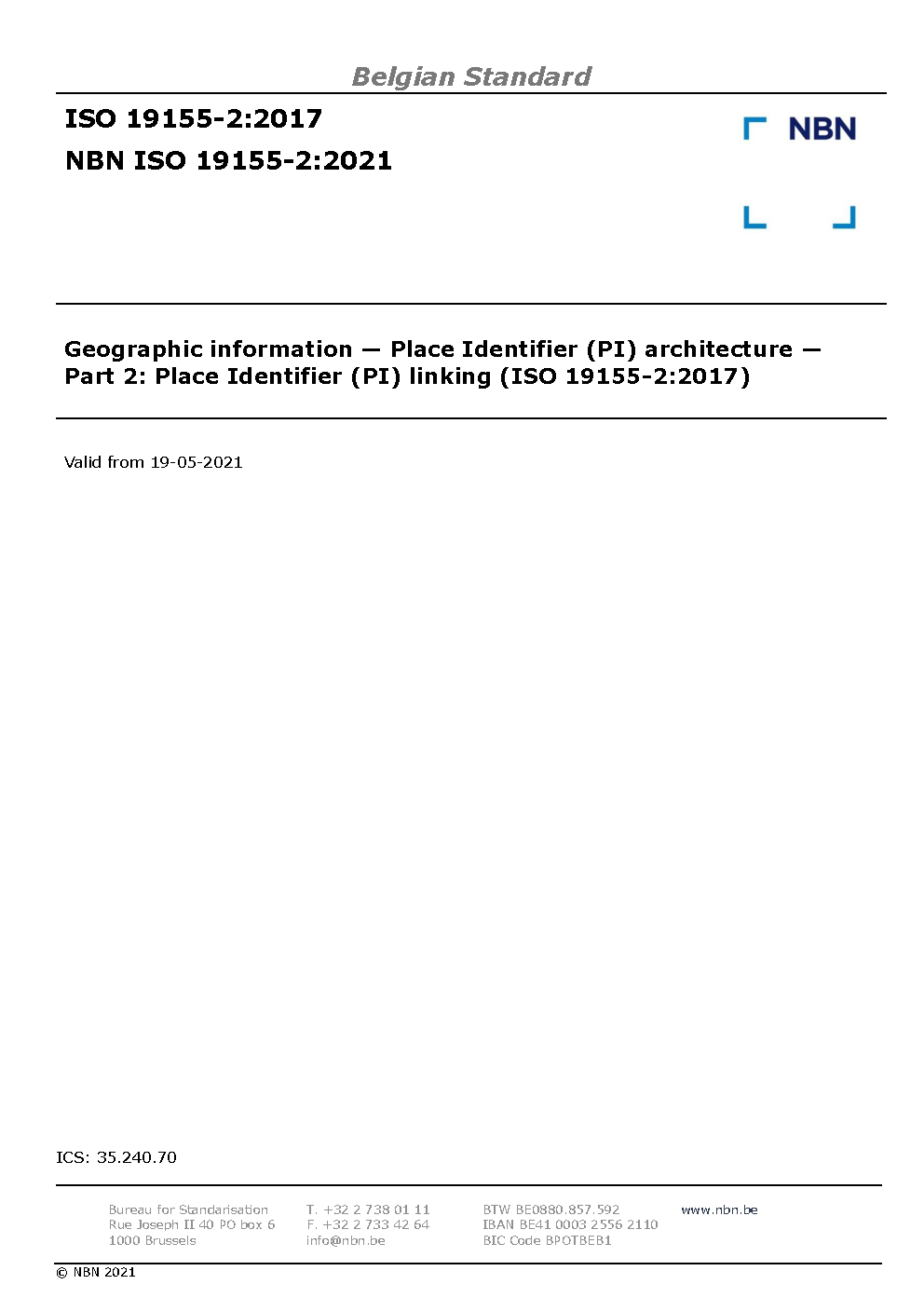
NBN ISO 19155-2:2021
Geographic information — Place Identifier (PI) architecture — Part 2: Place Identifier (PI) linking
 Preview
Summary
This document defines the following three mechanisms for linking Place Identifiers (PIs) (see ISO 19155)
to features or objects existing in other encodings:
— Id attribute of a GML object (gml:id) as defined in ISO 19136;
— Universally Unique Identifier (UUID) as defined in IETF RFC 4122;
— Uniform Resource Locator (URL) as defined in IETF RFC 1738.
These PI linking mechanisms are enabled using xlink: href as defined in W3C XML Linking Language
(XLink).
While the identifiers of these features or objects can sometimes identify a place, within the scope of
this document, the identifiers of features or objects existing in other encoding domains are referred to
conceptually as other identifiers.
This document further defines that when PIs are encoded, as specified in ISO 19155, using the
Geography Markup Language (GML) (ISO 19136), they are linked using gml:id to other GML encoded
features. The details of encoding GML instances using gml:id are specified in a normative annex.
Additional normative annexes define encodings for linking Place Identifiers to other identifiers using
UUID and URL and present examples for their use.
This document is applicable to location-based services, linked open data, robotic assisted services
and other application domains that require a relationship between PIs and objects in either the real or
virtual world.
This document is not about creating a registry of Place Identifiers linked to specific features or
objects, and support of linking mechanisms other than gml:id, UUID, and URL is out of the scope of this
document.
to features or objects existing in other encodings:
— Id attribute of a GML object (gml:id) as defined in ISO 19136;
— Universally Unique Identifier (UUID) as defined in IETF RFC 4122;
— Uniform Resource Locator (URL) as defined in IETF RFC 1738.
These PI linking mechanisms are enabled using xlink: href as defined in W3C XML Linking Language
(XLink).
While the identifiers of these features or objects can sometimes identify a place, within the scope of
this document, the identifiers of features or objects existing in other encoding domains are referred to
conceptually as other identifiers.
This document further defines that when PIs are encoded, as specified in ISO 19155, using the
Geography Markup Language (GML) (ISO 19136), they are linked using gml:id to other GML encoded
features. The details of encoding GML instances using gml:id are specified in a normative annex.
Additional normative annexes define encodings for linking Place Identifiers to other identifiers using
UUID and URL and present examples for their use.
This document is applicable to location-based services, linked open data, robotic assisted services
and other application domains that require a relationship between PIs and objects in either the real or
virtual world.
This document is not about creating a registry of Place Identifiers linked to specific features or
objects, and support of linking mechanisms other than gml:id, UUID, and URL is out of the scope of this
document.
Technical characteristics
| Publisher | Bureau de Normalisation Belge (NBN) |
| Publication Date | 05/19/2021 |
| Page Count | 37 |
| EAN | --- |
| ISBN | --- |
| Weight (in grams) | --- |
No products.
Previous versions
19/05/2021
Active
Most Recent
No products.