
Active
Standard
Most Recent
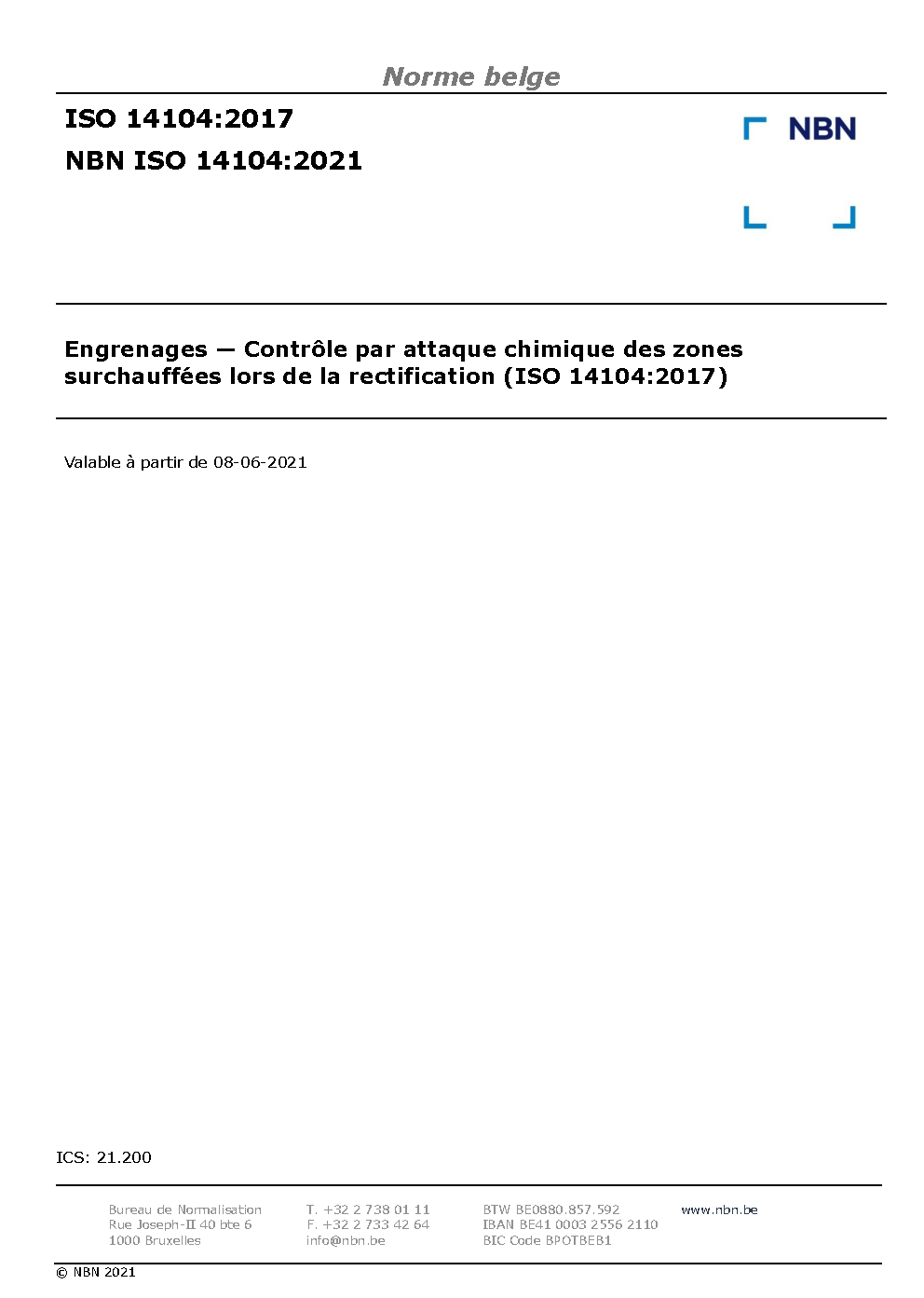
NBN ISO 14104:2021
Gears — Surface temper etch inspection after grinding, chemical method
 Preview
Summary
This document specifies procedures and requirements for the detection and classification of localized
overheating on ground surfaces by chemical etch methods.
The process described in this document is typically used on ground surfaces; however, it is also useful
for the detection of surface anomalies that result from post-heat treatment machining such as hard
turning, milling and edge breaking (deburring) processes. Surface metallurgical anomalies caused by
carburization or decarburization are also readily detectable with this process.
Some methods which have been used in the past are no longer recommended. Specifications are
intended to be changed to use the methods in this document. These etching methods are more sensitive
to changes in surface hardness than most hardness testing methods.
This document applies to steel parts such as gears, shafts, splines and bearings. It is not applicable to
nitrided parts and stainless steels.
NOTE This process, although at times called “nital etch”, is not intended to be confused with other processes
also known as “nital etch”.
The surface temper etch procedure is performed after grinding and before additional finishing
operations such as superfinishing, shot peening and honing.
overheating on ground surfaces by chemical etch methods.
The process described in this document is typically used on ground surfaces; however, it is also useful
for the detection of surface anomalies that result from post-heat treatment machining such as hard
turning, milling and edge breaking (deburring) processes. Surface metallurgical anomalies caused by
carburization or decarburization are also readily detectable with this process.
Some methods which have been used in the past are no longer recommended. Specifications are
intended to be changed to use the methods in this document. These etching methods are more sensitive
to changes in surface hardness than most hardness testing methods.
This document applies to steel parts such as gears, shafts, splines and bearings. It is not applicable to
nitrided parts and stainless steels.
NOTE This process, although at times called “nital etch”, is not intended to be confused with other processes
also known as “nital etch”.
The surface temper etch procedure is performed after grinding and before additional finishing
operations such as superfinishing, shot peening and honing.
Technical characteristics
| Publisher | Bureau de Normalisation Belge (NBN) |
| Publication Date | 06/08/2021 |
| Page Count | 26 |
| EAN | --- |
| ISBN | --- |
| Weight (in grams) | --- |
No products.
Previous versions
08/06/2021
Active
Most Recent
No products.