
Active
Draft standard
Most Recent
IEEE PN42.32
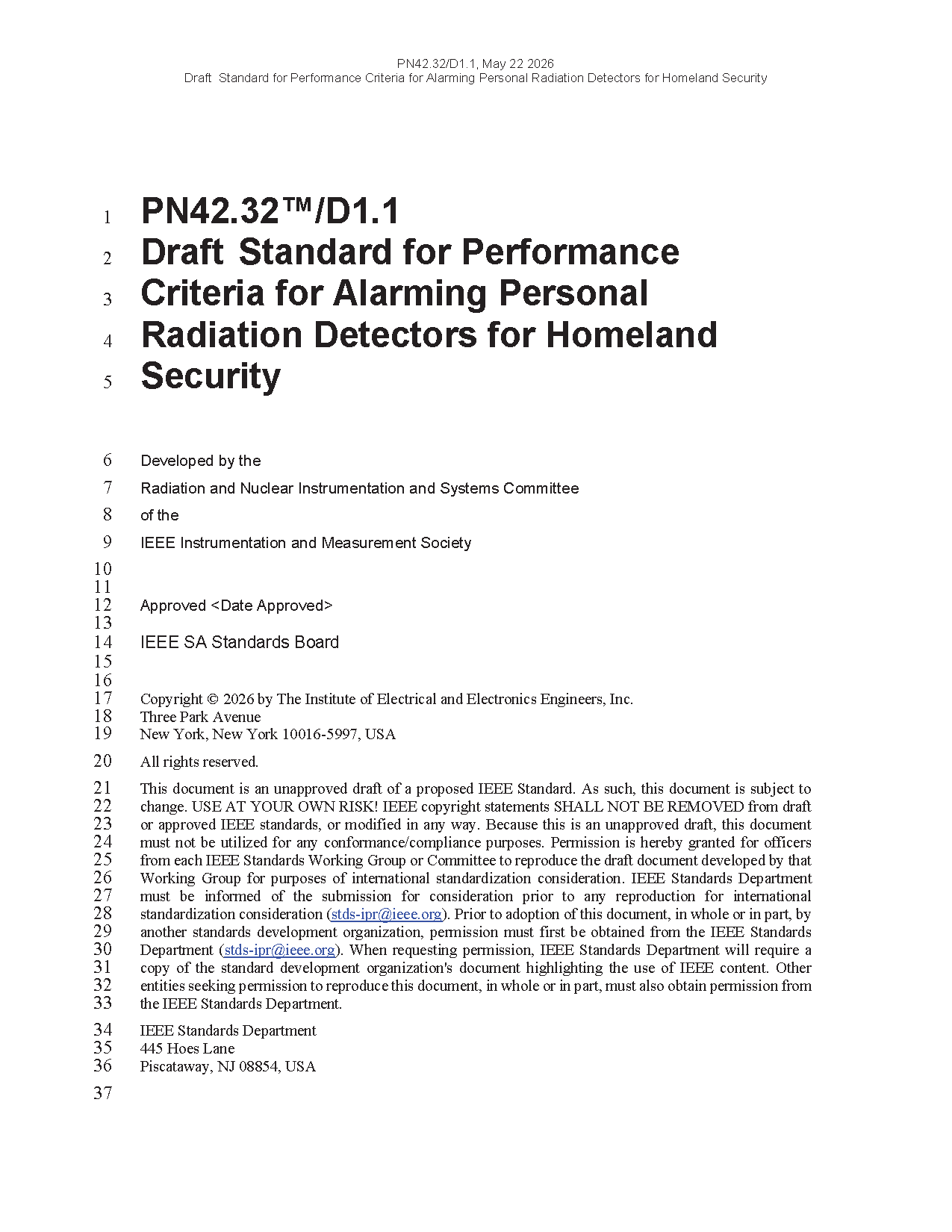
IEEE Draft Standard for Performance Criteria for Alarming Personal Radiation Detectors for Homeland Security
 Preview
Summary
New IEEE Standard - Active - Draft.
Minimum performance specifications and testing 1 methods for the evaluation of personal radiation detectors, also known as PRDs, are contained in this standard. These PRDs are small instruments that are body-worn by the user. These instruments are primarily designed for a fast response when detecting radioactive materials emitting gamma rays. This document does not apply to the performance of radiation protection instrumentation which is covered in other standards such as ANSI/IEEE N42.20, ANSI/IEEE N42.17AC, IEC 61526 and IEC 60846-1. PRDs are not intended to provide an accurate measurement of exposure (X), personal (Hp(10)) or ambient (H*(10)) dose equivalent (rate).The specifications for general, radiological, environmental, electromagnetic and mechanical performance are given and the corresponding testing methods are described. The documentation to be provided by the manufacturer is listed as part of the requirements. A number of informative annexes that provide useful information and guidance in implementing this standard are also contained in this standard.
This standard specifies minimum performance requirements and test methods for evaluating the performance of alarming personal radiation detectors (PRDs) for homeland security applications. The performance criteria contained in this standard provide means for verifying the capability of the PRDs to reliably detect changes above background levels of ionizing radiation fields and alert the user to these changes. The standard also specifies requirements and test methods for environmental, electromagnetic, and mechanical conditions that may affect the PRDs' response.
This standard does not apply to spectroscopic PRDs that have the ability to identify radionuclides. This standard does not apply to instruments that are primarily intended to provide a measurement of dose-equivalent, personal dose-equivalent, or ambient dose-equivalent rate.
PRDs are pocket-sized battery-powered alarming electronic instruments that are worn on the body and used to detect photon-emitting, and optionally neutron-emitting, radioactive materials. PRDs have user-readable displays related to the intensity of radiation, but they are distinct from, and typically more sensitive than, electronic personal dosimeters, which are designed to measure the dose equivalent to workers occupationally exposed to radiation. This standard helps to ensure the proper functioning of PRDs thereby increasing trust in the device's measurement results.
Minimum performance specifications and testing 1 methods for the evaluation of personal radiation detectors, also known as PRDs, are contained in this standard. These PRDs are small instruments that are body-worn by the user. These instruments are primarily designed for a fast response when detecting radioactive materials emitting gamma rays. This document does not apply to the performance of radiation protection instrumentation which is covered in other standards such as ANSI/IEEE N42.20, ANSI/IEEE N42.17AC, IEC 61526 and IEC 60846-1. PRDs are not intended to provide an accurate measurement of exposure (X), personal (Hp(10)) or ambient (H*(10)) dose equivalent (rate).The specifications for general, radiological, environmental, electromagnetic and mechanical performance are given and the corresponding testing methods are described. The documentation to be provided by the manufacturer is listed as part of the requirements. A number of informative annexes that provide useful information and guidance in implementing this standard are also contained in this standard.
This standard specifies minimum performance requirements and test methods for evaluating the performance of alarming personal radiation detectors (PRDs) for homeland security applications. The performance criteria contained in this standard provide means for verifying the capability of the PRDs to reliably detect changes above background levels of ionizing radiation fields and alert the user to these changes. The standard also specifies requirements and test methods for environmental, electromagnetic, and mechanical conditions that may affect the PRDs' response.
This standard does not apply to spectroscopic PRDs that have the ability to identify radionuclides. This standard does not apply to instruments that are primarily intended to provide a measurement of dose-equivalent, personal dose-equivalent, or ambient dose-equivalent rate.
PRDs are pocket-sized battery-powered alarming electronic instruments that are worn on the body and used to detect photon-emitting, and optionally neutron-emitting, radioactive materials. PRDs have user-readable displays related to the intensity of radiation, but they are distinct from, and typically more sensitive than, electronic personal dosimeters, which are designed to measure the dose equivalent to workers occupationally exposed to radiation. This standard helps to ensure the proper functioning of PRDs thereby increasing trust in the device's measurement results.
Notes
Active
Technical characteristics
| Publisher | Institute of Electrical and Electronics Engineers (IEEE) |
| Publication Date | 06/13/2026 |
| Page Count | 78 |
| EAN | --- |
| ISBN | --- |
| Weight (in grams) | --- |
Replaces
Previous versions

No products.