
Active
Draft standard
Most Recent
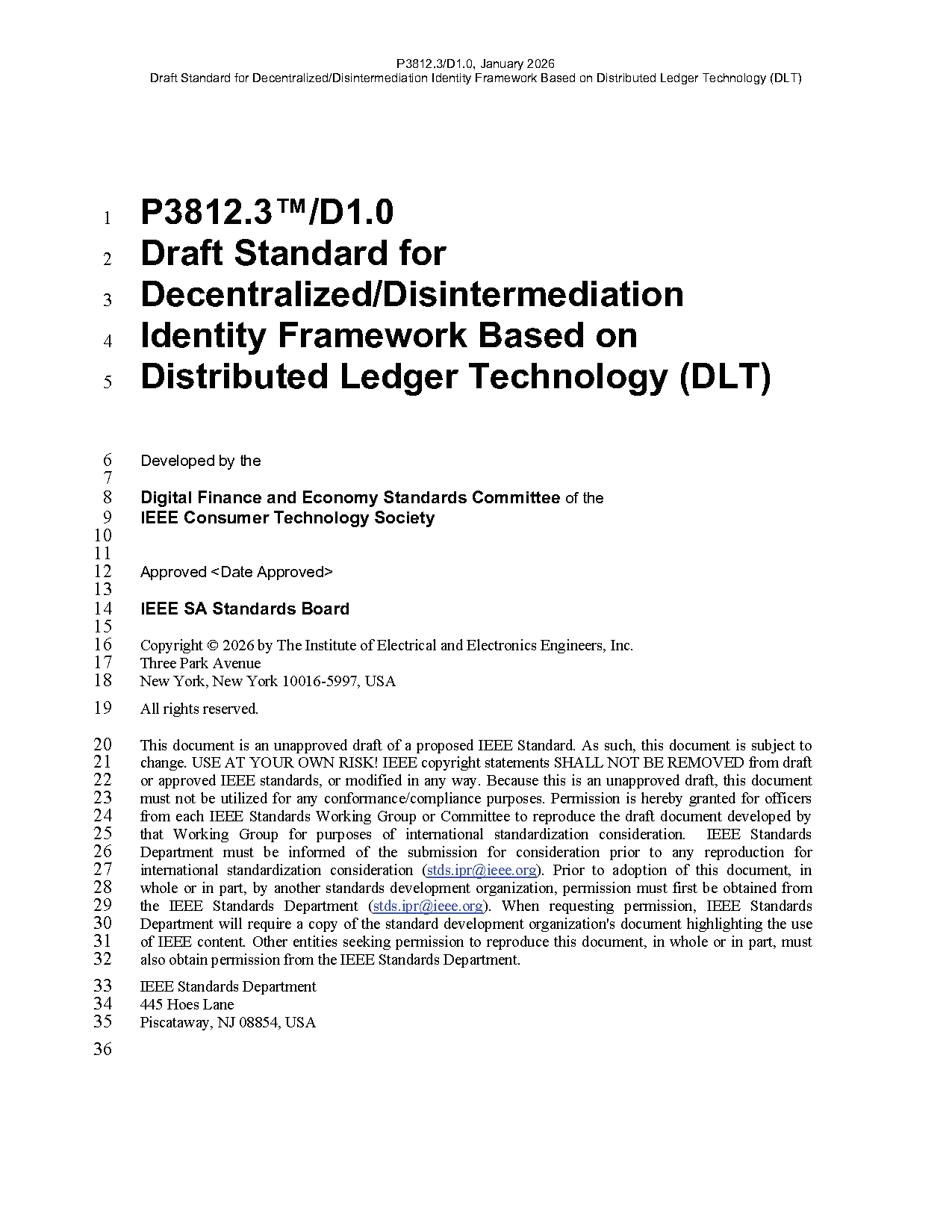
IEEE P3812.3
IEEE Draft Standard for Decentralized/Disintermediation Identity Framework Based on Distributed Ledger Technology (DLT)
 Preview
Summary
New IEEE Standard - Active - Draft.
The standard describes the establishment and implementation of a decentralized identity framework that utilizes distributed ledger technology (DLT) as its underlying trust anchor. Its goal is to promote open interoperability across various systems, providing reliable entity identification and universal access management. The framework, combined with blockchain technology and network protocols, enables trustless, open operations previously limited to closed systems, and multi-system interoperability rooted in autonomous identity. Together, these elements create a trustless environment that enables entities to independently verify identities and credentials without the need for centralized oversight. The goal of the framework is to unify identity transaction interfaces, thereby facilitating smooth interactions with external components and third-party services.
This standard defines a framework of decentralized/disintermediation identity for data interoperability across systems, which uses Distributed Ledger Technology (DLT) system as trust middleware for entity recognition, identifier mapping, meta-role control and access management across systems. Cryptographic solutions to provide data privacy and data protection are involved in the scope of the identity framework. This standard also defines a series of extendable identity interfaces in interoperation scenario, to dock third-party utility components like compliance and regulation.
The standard describes the establishment and implementation of a decentralized identity framework that utilizes distributed ledger technology (DLT) as its underlying trust anchor. Its goal is to promote open interoperability across various systems, providing reliable entity identification and universal access management. The framework, combined with blockchain technology and network protocols, enables trustless, open operations previously limited to closed systems, and multi-system interoperability rooted in autonomous identity. Together, these elements create a trustless environment that enables entities to independently verify identities and credentials without the need for centralized oversight. The goal of the framework is to unify identity transaction interfaces, thereby facilitating smooth interactions with external components and third-party services.
This standard defines a framework of decentralized/disintermediation identity for data interoperability across systems, which uses Distributed Ledger Technology (DLT) system as trust middleware for entity recognition, identifier mapping, meta-role control and access management across systems. Cryptographic solutions to provide data privacy and data protection are involved in the scope of the identity framework. This standard also defines a series of extendable identity interfaces in interoperation scenario, to dock third-party utility components like compliance and regulation.
Notes
Active
Technical characteristics
| Publisher | Institute of Electrical and Electronics Engineers (IEEE) |
| Publication Date | 04/04/2026 |
| Page Count | 23 |
| EAN | --- |
| ISBN | --- |
| Weight (in grams) | --- |
No products.
Previous versions
No products.