
Active
Draft standard
Most Recent
IEEE P3398
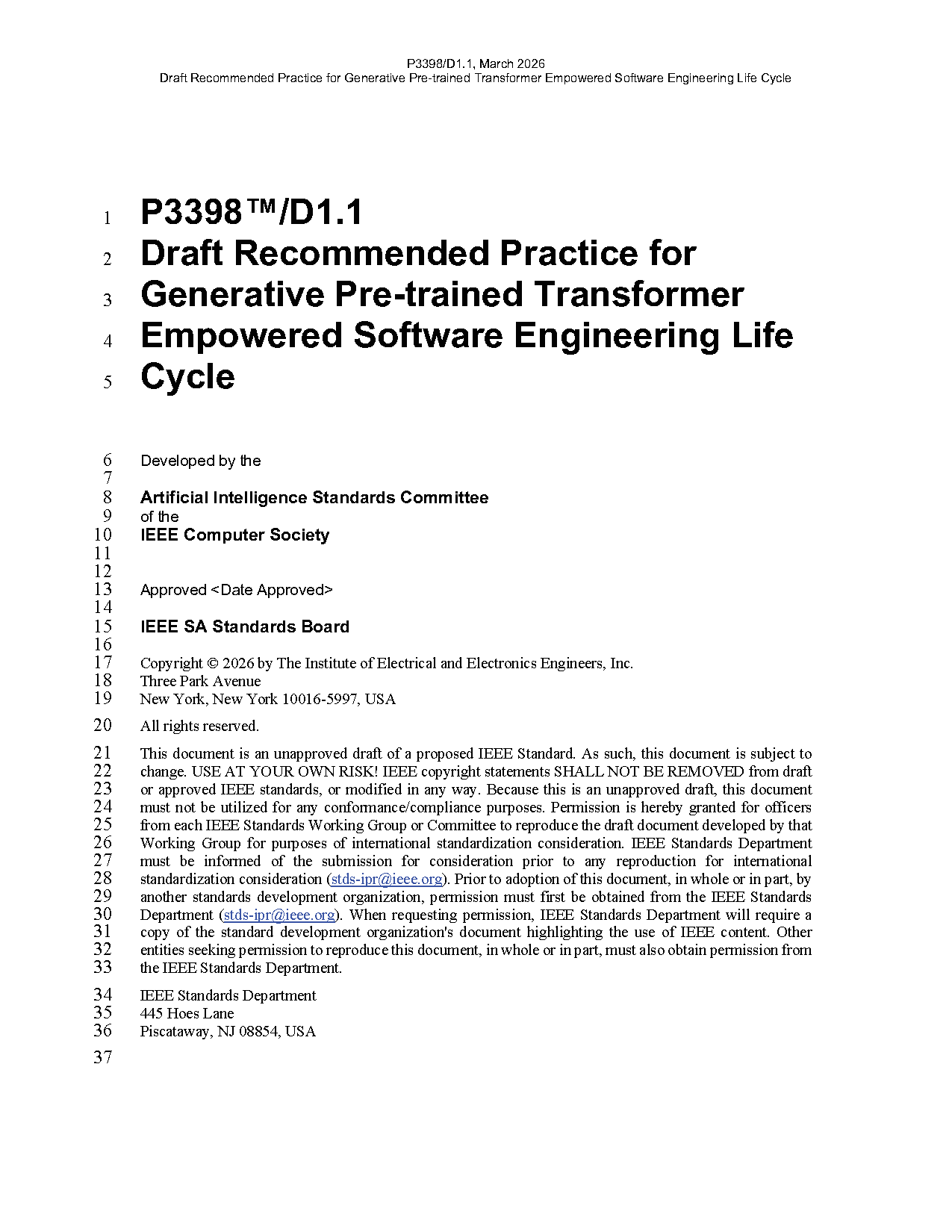
IEEE Draft Recommended Practice for Generative Pre-trained Transformer Empowered Software Engineering Life Cycle
 Preview
Summary
New IEEE Standard - Active - Draft.
This recommended practice specifies a structured framework for integrating Generative Pre-trained Transformer (GPT) into the software engineering life cycle (SELC). It defines intelligence levels, competency requirements, and evaluation methods for GPT-powered software development, covering all stages from requirements analysis, design, coding, and testing to delivery and operation. The framework is intended to help organizations assess, plan, and govern the progressive adoption of GPT-based capabilities in engineering practice.
For the software engineering life cycle empowered by Generative Pre-trained Transformer (GPT) this recommended practice specifies: • a description and definitions, • the competency in each stage applying GPT, • levels of intelligence empowered by GPT, • intelligence level evaluation methods. A generative pre-trained transformer (GPT) is a type of neural network architecture used in natural language processing (NLP) applications. GPTs are transformational self-supervised NLP models that can generate human-like language and fine-tune to various downstream tasks, enabled by their pre-training approach and large transformer architectures.
This document provides a constructive recommended practice to improve the intelligent assisted Software Engineering Life Cycle, and present intelligence level reference. GPT empowered software engineering life cycles help software customers, producers, consumers, and collaborators to realize multiple intelligence assistance levels in each stage of the software engineering life cycle. This enhances efficiency, quality, and reliability of a intelligently assisted software engineering life cycle. This recommended practice includes an analysis of the impact of Artificial Intelligence (AI) on all aspects of the entire life cycle of software development.
This recommended practice specifies a structured framework for integrating Generative Pre-trained Transformer (GPT) into the software engineering life cycle (SELC). It defines intelligence levels, competency requirements, and evaluation methods for GPT-powered software development, covering all stages from requirements analysis, design, coding, and testing to delivery and operation. The framework is intended to help organizations assess, plan, and govern the progressive adoption of GPT-based capabilities in engineering practice.
For the software engineering life cycle empowered by Generative Pre-trained Transformer (GPT) this recommended practice specifies: • a description and definitions, • the competency in each stage applying GPT, • levels of intelligence empowered by GPT, • intelligence level evaluation methods. A generative pre-trained transformer (GPT) is a type of neural network architecture used in natural language processing (NLP) applications. GPTs are transformational self-supervised NLP models that can generate human-like language and fine-tune to various downstream tasks, enabled by their pre-training approach and large transformer architectures.
This document provides a constructive recommended practice to improve the intelligent assisted Software Engineering Life Cycle, and present intelligence level reference. GPT empowered software engineering life cycles help software customers, producers, consumers, and collaborators to realize multiple intelligence assistance levels in each stage of the software engineering life cycle. This enhances efficiency, quality, and reliability of a intelligently assisted software engineering life cycle. This recommended practice includes an analysis of the impact of Artificial Intelligence (AI) on all aspects of the entire life cycle of software development.
Notes
Active
Technical characteristics
| Publisher | Institute of Electrical and Electronics Engineers (IEEE) |
| Publication Date | 04/30/2026 |
| Page Count | 57 |
| EAN | --- |
| ISBN | --- |
| Weight (in grams) | --- |
No products.
Previous versions
No products.