
Active
Draft standard
Most Recent
IEEE P3157
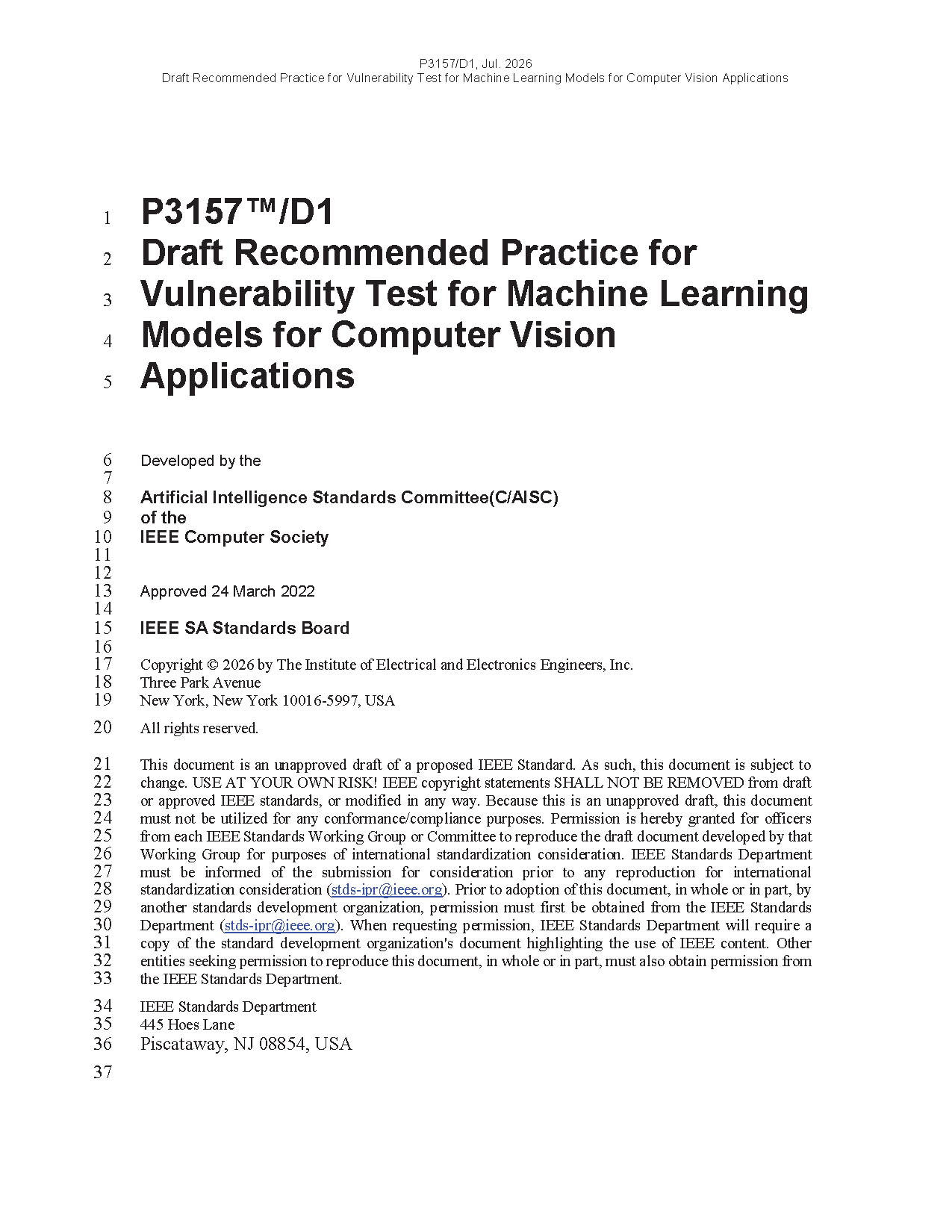
IEEE Draft Recommended Practice for Vulnerability Test for Machine Learning Models for Computer Vision Applications
 Preview
Summary
New IEEE Standard - Active - Draft.
Machine learning models are widely used in the computer vision do main owing to their improved prediction accuracy in comparison with non-machine learning approaches. Vulnerabilities (prediction error or bias caused by external attacks and data quality deficiencies) of those models are critical to AI system providers and end-users, since the model vulnerabilities will affect the effectiveness of AI systems. Academic approaches and tools for model vulnerability tests can vary in terms of applicable scenarios, settings and test qualities. For end-users, it is difficult to correctly choose, combine, and apply the vulnerability tests without a systematic framework introducing principles, approaches’ characteristics, trade-off and metrics. In addition, key aspects, including test termination condition and completeness are important for test quality, but often failed to be applied by testers, due to the lack of specifications. This document provides recommended practices for vulnerability testing of machine learning models for computer vision applications. It covers testing approaches and operational contexts for primary tasks including object detection, semantic segmentation, classification, image / video modification and understanding.
This recommended practice provides a framework for vulnerability tests for machine learning models in the computer vision domain. The document covers the following areas: - definitions of vulnerabilities for machine learning models and their training processes, - approaches for the selection and application of vulnerability test means, - approaches for determining test completeness and termination criteria, - metrics of vulnerabilities and test completeness.
Machine learning models are widely used in the computer vision do main owing to their improved prediction accuracy in comparison with non-machine learning approaches. Vulnerabilities (prediction error or bias caused by external attacks and data quality deficiencies) of those models are critical to AI system providers and end-users, since the model vulnerabilities will affect the effectiveness of AI systems. Academic approaches and tools for model vulnerability tests can vary in terms of applicable scenarios, settings and test qualities. For end-users, it is difficult to correctly choose, combine, and apply the vulnerability tests without a systematic framework introducing principles, approaches’ characteristics, trade-off and metrics. In addition, key aspects, including test termination condition and completeness are important for test quality, but often failed to be applied by testers, due to the lack of specifications. This document provides recommended practices for vulnerability testing of machine learning models for computer vision applications. It covers testing approaches and operational contexts for primary tasks including object detection, semantic segmentation, classification, image / video modification and understanding.
This recommended practice provides a framework for vulnerability tests for machine learning models in the computer vision domain. The document covers the following areas: - definitions of vulnerabilities for machine learning models and their training processes, - approaches for the selection and application of vulnerability test means, - approaches for determining test completeness and termination criteria, - metrics of vulnerabilities and test completeness.
Notes
Active
Technical characteristics
| Publisher | Institute of Electrical and Electronics Engineers (IEEE) |
| Publication Date | 07/08/2026 |
| Page Count | 43 |
| EAN | --- |
| ISBN | --- |
| Weight (in grams) | --- |
No products.
Previous versions
No products.