Active
Draft standard
Most Recent
IEEE P1901
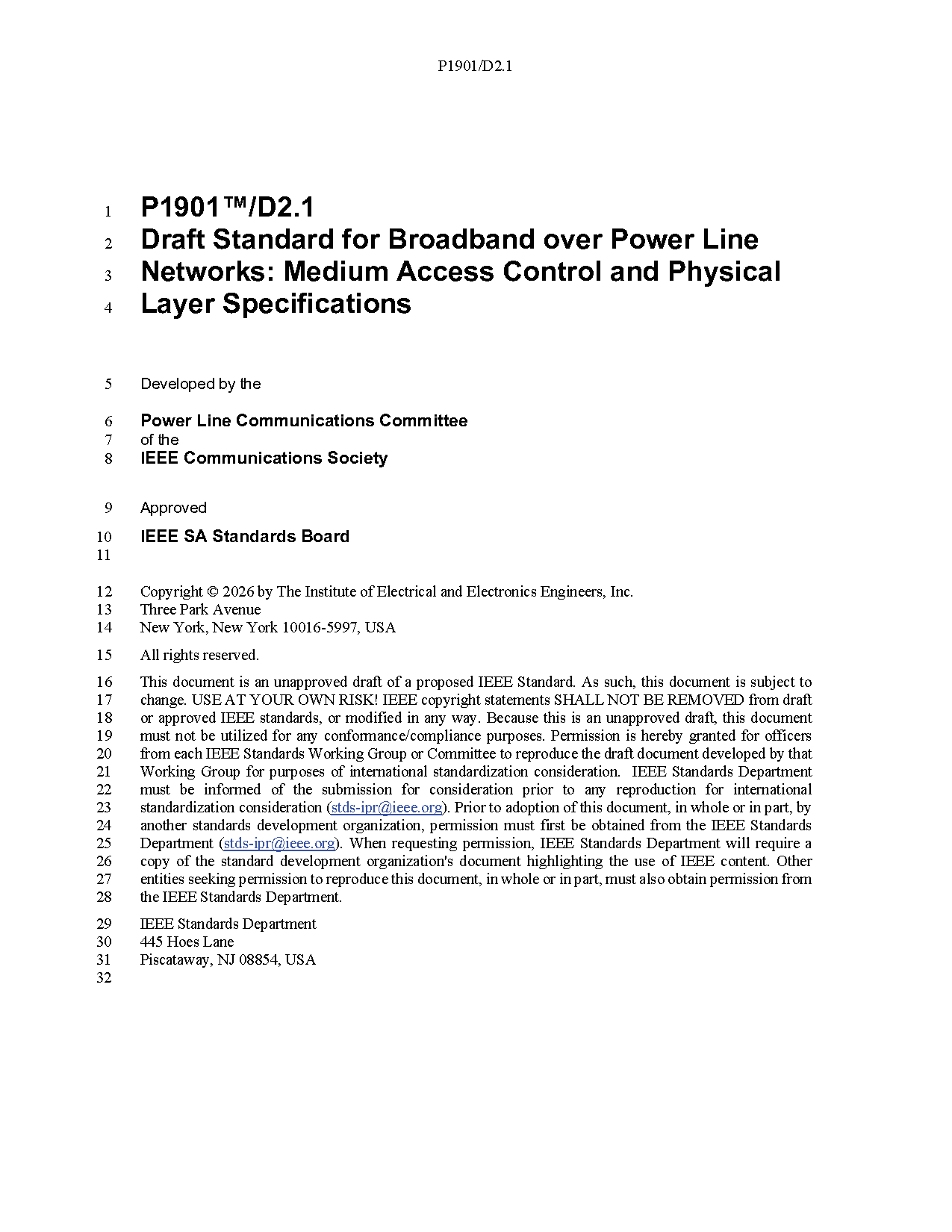
IEEE Draft Standard for Broadband over Power Line Networks: Medium Access Control and Physical Layer Specifications
 Preview
Summary
Revision Standard - Active - Draft.
The Physical (PHY) and Media Access Control (MAC) layers for broadband communications are specified in this standard, supporting applications such as local area networks (LANs), Smart Energy, Smart Grid, Internet of Things (IoT), transportation platforms (vehicle), and other data distribution applications. A flexible channel wavelet (FCW) and extended FCW PHY/MAC technology is specified to enable adaptation to different frequency bands and to support communication over various transmission media, including but not limited to, power lines (ac or dc), coaxial cables, signal cables, optical fiber, light (visible, infrared), and radio waves. FCW and extended FCW communication channels in low-frequency bands are defined to extend communication range and improve robustness. Support for network synchronization and enhanced network functionality through the IEEE Std 1588™ Precision Time Protocol (PTP) is specified. State-of-the-art security mechanisms are integrated, including authentication and authorization capabilities suitable for IoT and access devices. The use of IEEE Std 802.1X™ within IEEE Std 1901™ networks is specified to provide secure access control and to protect the privacy and integrity of communications, thereby enabling the use of the technology for security-sensitive services. Mechanisms for coexistence and interoperability between different Broadband over Power Lines (BPL) devices are specified, ensuring efficient use of the power line channel and the provision of required communication bandwidth and quality of service.
This standard defines medium access control (MAC) and physical layer (PHY) specifications for high-speed (>100 Mb/s at the physical layer) communication devices as well as lower speed Internet of Things communication devices. It is usable for communications on any media including, but not limited to, communications on power lines (AC or DC), coaxial cables, signal cables, optical fiber, and communications using light (visible, infrared), and radio waves. The standard applies to communication devices used for local area networks (LANs), in buildings, Smart Energy/Smart Grid applications, transportation platforms (vehicle, bike, robot) applications, underwater applications, Internet of Things applications, and other data distribution. This standard defines how to apply PHY/MAC specifications for transmission over various media (e.g., communications on power lines, coaxial cables, signal cables, underwater communication, near field communications using loop antennas). This standard uses transmission frequencies below 100 MHz for communications on power lines and transmission frequencies below 125 MHz for communications on coaxial cables, signal cables or using radio waves. The standard addresses security, privacy, authentication, and authorization to provide secure communications and network operations. Therefore, the standard supports operating security-sensitive services. The standard limits itself to the physical layer and the medium access sublayer of the data link layer, as defined by the International Organization for Standardization (ISO) Open Systems Interconnection (OSI) Basic Reference Model. The standard addresses all classes of broadband over power line (BPL) devices, including BPL devices used for the first-mile/last-mile connection (at least 1500 m to the premises) to broadband services as well as BPL devices used in buildings for LANs. This standard defines detailed mechanisms for coexistence and interoperability between different BPL devices helping to assure a balanced and efficient use of the power line communications medium by all classes of BPL devices, and that desired bandwidth and quality of service may be delivered. The standard also enables compliance with electromagnetic compatibility (EMC) limits for communications on power lines and communications using radio waves set by national regulators.
New modulation techniques offer the possibility to use any media for high-speed or long-range (lower speed) communications. The standard enables a seamless integration with other networking protocols, such as bridging for seamless interconnection via the IEEE 802.1 series of Standards for Local and Metropolitan Area Network and enables seamless communications over different media and between high-speed and long-range (lower speed) networks.
The Physical (PHY) and Media Access Control (MAC) layers for broadband communications are specified in this standard, supporting applications such as local area networks (LANs), Smart Energy, Smart Grid, Internet of Things (IoT), transportation platforms (vehicle), and other data distribution applications. A flexible channel wavelet (FCW) and extended FCW PHY/MAC technology is specified to enable adaptation to different frequency bands and to support communication over various transmission media, including but not limited to, power lines (ac or dc), coaxial cables, signal cables, optical fiber, light (visible, infrared), and radio waves. FCW and extended FCW communication channels in low-frequency bands are defined to extend communication range and improve robustness. Support for network synchronization and enhanced network functionality through the IEEE Std 1588™ Precision Time Protocol (PTP) is specified. State-of-the-art security mechanisms are integrated, including authentication and authorization capabilities suitable for IoT and access devices. The use of IEEE Std 802.1X™ within IEEE Std 1901™ networks is specified to provide secure access control and to protect the privacy and integrity of communications, thereby enabling the use of the technology for security-sensitive services. Mechanisms for coexistence and interoperability between different Broadband over Power Lines (BPL) devices are specified, ensuring efficient use of the power line channel and the provision of required communication bandwidth and quality of service.
This standard defines medium access control (MAC) and physical layer (PHY) specifications for high-speed (>100 Mb/s at the physical layer) communication devices as well as lower speed Internet of Things communication devices. It is usable for communications on any media including, but not limited to, communications on power lines (AC or DC), coaxial cables, signal cables, optical fiber, and communications using light (visible, infrared), and radio waves. The standard applies to communication devices used for local area networks (LANs), in buildings, Smart Energy/Smart Grid applications, transportation platforms (vehicle, bike, robot) applications, underwater applications, Internet of Things applications, and other data distribution. This standard defines how to apply PHY/MAC specifications for transmission over various media (e.g., communications on power lines, coaxial cables, signal cables, underwater communication, near field communications using loop antennas). This standard uses transmission frequencies below 100 MHz for communications on power lines and transmission frequencies below 125 MHz for communications on coaxial cables, signal cables or using radio waves. The standard addresses security, privacy, authentication, and authorization to provide secure communications and network operations. Therefore, the standard supports operating security-sensitive services. The standard limits itself to the physical layer and the medium access sublayer of the data link layer, as defined by the International Organization for Standardization (ISO) Open Systems Interconnection (OSI) Basic Reference Model. The standard addresses all classes of broadband over power line (BPL) devices, including BPL devices used for the first-mile/last-mile connection (at least 1500 m to the premises) to broadband services as well as BPL devices used in buildings for LANs. This standard defines detailed mechanisms for coexistence and interoperability between different BPL devices helping to assure a balanced and efficient use of the power line communications medium by all classes of BPL devices, and that desired bandwidth and quality of service may be delivered. The standard also enables compliance with electromagnetic compatibility (EMC) limits for communications on power lines and communications using radio waves set by national regulators.
New modulation techniques offer the possibility to use any media for high-speed or long-range (lower speed) communications. The standard enables a seamless integration with other networking protocols, such as bridging for seamless interconnection via the IEEE 802.1 series of Standards for Local and Metropolitan Area Network and enables seamless communications over different media and between high-speed and long-range (lower speed) networks.
Notes
Active
Technical characteristics
| Publisher | Institute of Electrical and Electronics Engineers (IEEE) |
| Publication Date | 04/30/2026 |
| Page Count | 1727 |
| EAN | --- |
| ISBN | --- |
| Weight (in grams) | --- |
Replaces
Previous versions
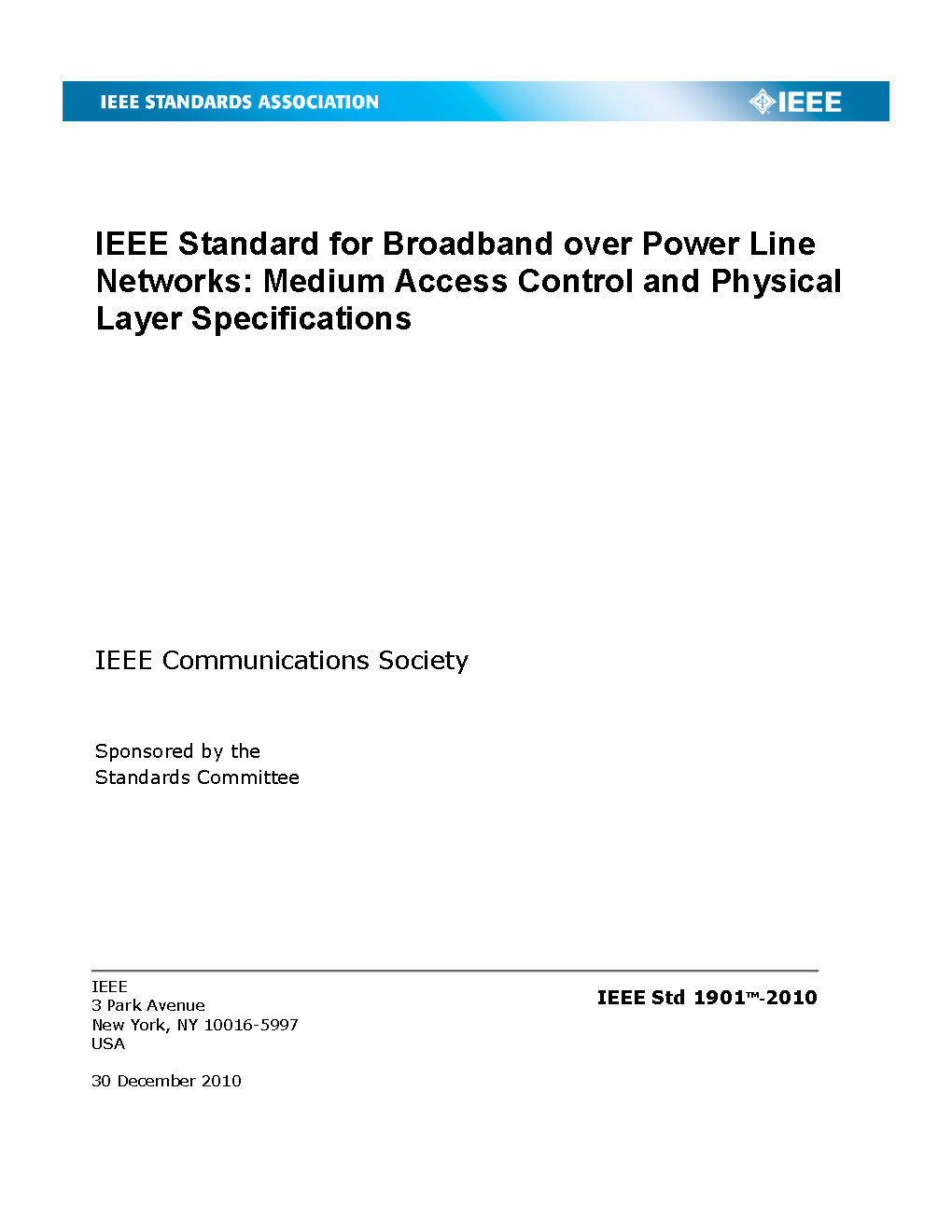
30/12/2010
Superseded
Historical
No products.