
Active
Draft standard
Most Recent
IEEE P1855
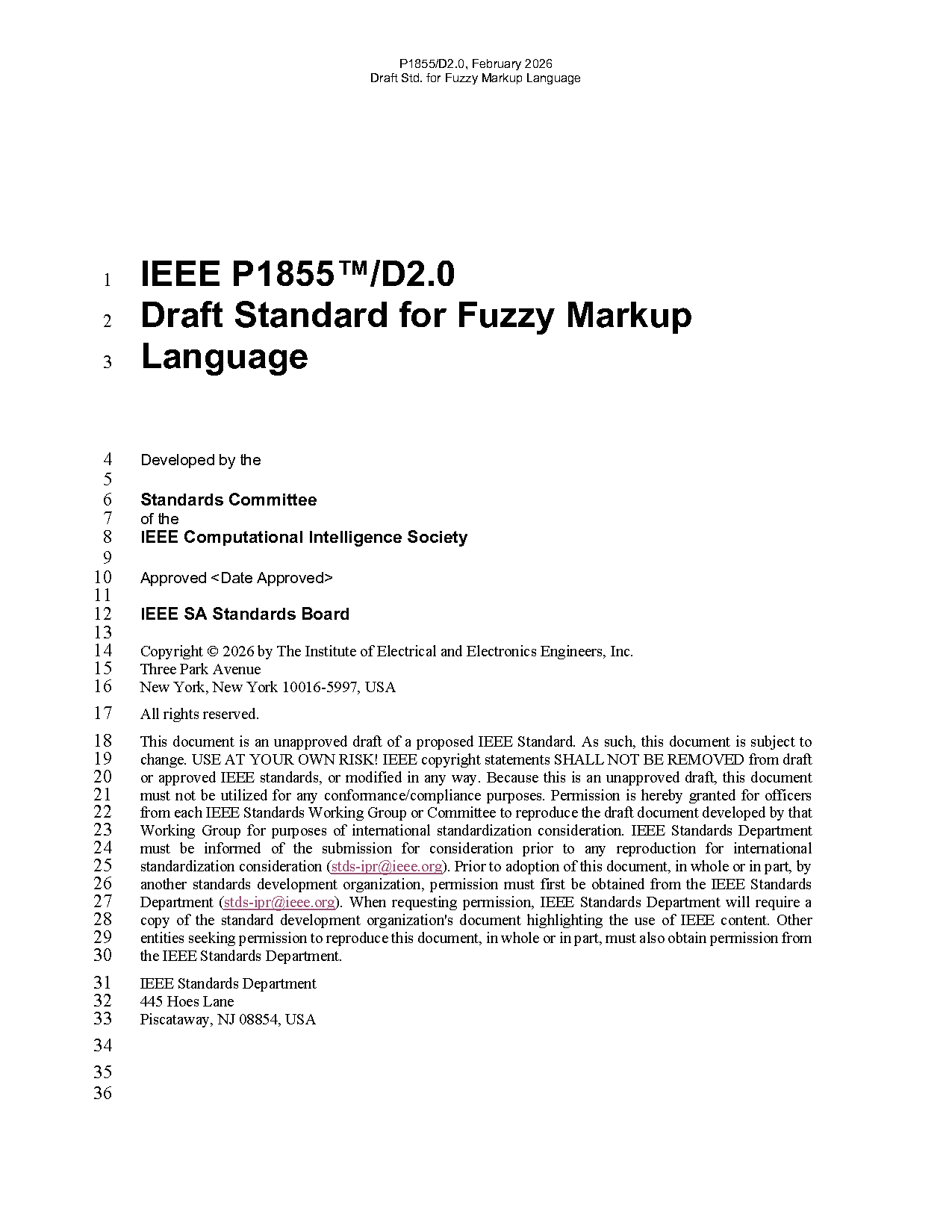
IEEE Draft Standard for Fuzzy Markup Language
 Preview
Summary
Revision Standard - Active - Draft.
This standard presents a new specification language, named Fuzzy Markup Language (FML), exploiting the benefits offered by eXtensible Markup Language (XML) specifications and related tools in order to model a fuzzy logic system in a human-readable and hardware independent way. Therefore, it provides designers of industrial fuzzy systems with a unified and high-level methodology for describing interoperable fuzzy systems. This Standard uses the W3C XML Schema definition language to define the syntax and semantics of the FML programs.
This standard defines an eXtensible Markup Language (XML)-based language, named Fuzzy Markup Language (FML), aimed at providing a unified and well-defined representation of Fuzzy Logic Systems (FLSs). This standard includes an extendable schema that natively defines the basic components of an FLS and enables the modeling of different categories of fuzzy inference engines.
This standard allows for the creation of interoperable FLSs. This standard uses the W3C XML Schema Definition (XSD) language as the encoder, which allows for interoperability and the exchange of XML-based FLS instances between various systems. Different from other approaches used to describe fuzzy systems such as Fuzzy Control Language (FCL), FML allows fuzzy designers to simply code their ideas on heterogeneous hardware without need for a deep understanding of details related to the different platforms. This approach enables fuzzy systems designers to achieve design transparency. It means that, by using FML, it is possible to implement the same FLS on different hardware architectures with minimal effort and without additional design and implementation steps. In short, FML makes it possible to model an FLS in a human-readable and hardware-independent way.
This standard presents a new specification language, named Fuzzy Markup Language (FML), exploiting the benefits offered by eXtensible Markup Language (XML) specifications and related tools in order to model a fuzzy logic system in a human-readable and hardware independent way. Therefore, it provides designers of industrial fuzzy systems with a unified and high-level methodology for describing interoperable fuzzy systems. This Standard uses the W3C XML Schema definition language to define the syntax and semantics of the FML programs.
This standard defines an eXtensible Markup Language (XML)-based language, named Fuzzy Markup Language (FML), aimed at providing a unified and well-defined representation of Fuzzy Logic Systems (FLSs). This standard includes an extendable schema that natively defines the basic components of an FLS and enables the modeling of different categories of fuzzy inference engines.
This standard allows for the creation of interoperable FLSs. This standard uses the W3C XML Schema Definition (XSD) language as the encoder, which allows for interoperability and the exchange of XML-based FLS instances between various systems. Different from other approaches used to describe fuzzy systems such as Fuzzy Control Language (FCL), FML allows fuzzy designers to simply code their ideas on heterogeneous hardware without need for a deep understanding of details related to the different platforms. This approach enables fuzzy systems designers to achieve design transparency. It means that, by using FML, it is possible to implement the same FLS on different hardware architectures with minimal effort and without additional design and implementation steps. In short, FML makes it possible to model an FLS in a human-readable and hardware-independent way.
Notes
Active
Technical characteristics
| Publisher | Institute of Electrical and Electronics Engineers (IEEE) |
| Publication Date | 06/09/2026 |
| Page Count | 94 |
| EAN | --- |
| ISBN | --- |
| Weight (in grams) | --- |
Replaces

Previous versions
No products.