
Active
Draft standard
Most Recent
IEEE P1242
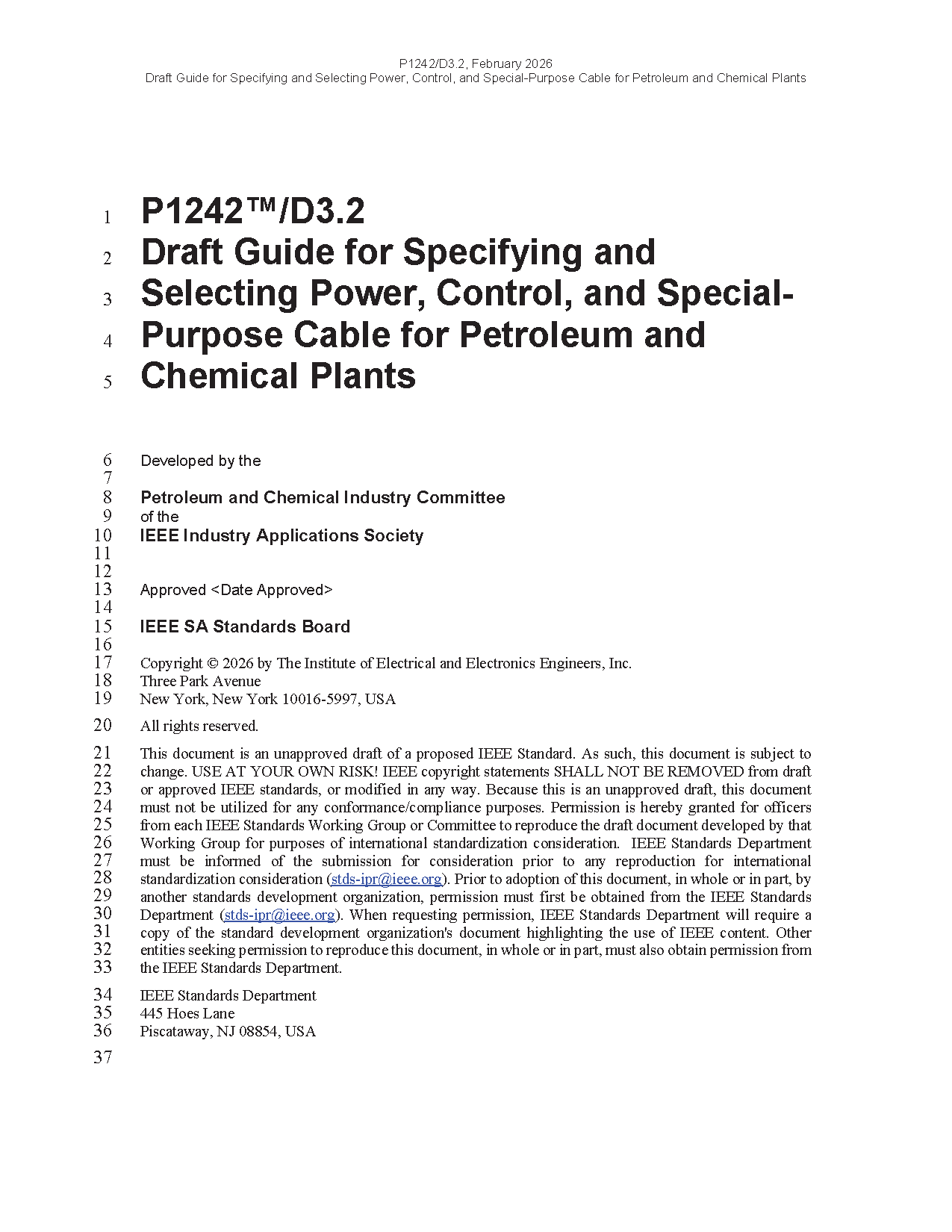
IEEE Draft Guide for Specifying and Selecting Power, Control, and Special-Purpose Cable for Petroleum and Chemical Plants
 Preview
Summary
Revision Standard - Active - Draft.
Information on the specification and selection of power, control, and special-purpose cable, as typically used in petroleum, chemical, and similar plants, is provided in this guide. Materials, design, testing, and applications are addressed. More recent developments, such as strand filling, low smoke, zero-halogen materials, chemical-moisture barriers, and fire-resistive cables have been included.
This guide provides information on the specification and selection of power, control, and special-purpose cable, as typically used in petroleum, chemical, and similar plants. It addresses materials, design, testing, installations, and applications. More recent developments, such as fire-rated circuit integrity cables are included. This guide is not intended to be a design document, although many of the problems associated with the specification and selection of power, control, and special-purpose cable for petroleum and chemical plant applications can be avoided by considering the information presented in this guide. It is recognized that there may be other types of cable used in the petroleum and chemical industries, especially considering the global marketplace. This guide does not preclude the use of such cables.
The purpose of this guide is to provide the user with cable designs, applications, and test procedures that are common to the petroleum, chemical, or similar type of industry. It is intended as an informational tool for the new as well as the more seasoned engineer. In this capacity, it contains an extensive cross-reference list of standards as they apply to the wire and cable industry, including U.S. and Canadian standards. It provides application guidelines for the type of installations found in petroleum and chemical plants as they relate to electrical, mechanical, physical, thermal, and environmental properties of the cable. The use of this guide helps to eliminate premature cable failure due to improper specification, selection, and application of cable in petroleum and chemical plants.
Information on the specification and selection of power, control, and special-purpose cable, as typically used in petroleum, chemical, and similar plants, is provided in this guide. Materials, design, testing, and applications are addressed. More recent developments, such as strand filling, low smoke, zero-halogen materials, chemical-moisture barriers, and fire-resistive cables have been included.
This guide provides information on the specification and selection of power, control, and special-purpose cable, as typically used in petroleum, chemical, and similar plants. It addresses materials, design, testing, installations, and applications. More recent developments, such as fire-rated circuit integrity cables are included. This guide is not intended to be a design document, although many of the problems associated with the specification and selection of power, control, and special-purpose cable for petroleum and chemical plant applications can be avoided by considering the information presented in this guide. It is recognized that there may be other types of cable used in the petroleum and chemical industries, especially considering the global marketplace. This guide does not preclude the use of such cables.
The purpose of this guide is to provide the user with cable designs, applications, and test procedures that are common to the petroleum, chemical, or similar type of industry. It is intended as an informational tool for the new as well as the more seasoned engineer. In this capacity, it contains an extensive cross-reference list of standards as they apply to the wire and cable industry, including U.S. and Canadian standards. It provides application guidelines for the type of installations found in petroleum and chemical plants as they relate to electrical, mechanical, physical, thermal, and environmental properties of the cable. The use of this guide helps to eliminate premature cable failure due to improper specification, selection, and application of cable in petroleum and chemical plants.
Notes
Active
Technical characteristics
| Publisher | Institute of Electrical and Electronics Engineers (IEEE) |
| Publication Date | 03/26/2026 |
| Page Count | 120 |
| EAN | --- |
| ISBN | --- |
| Weight (in grams) | --- |
Replaces
Previous versions

31/08/1999
Superseded
, Reaffirmed
Historical

No products.