
Active
, Modified
Standard
Most Recent
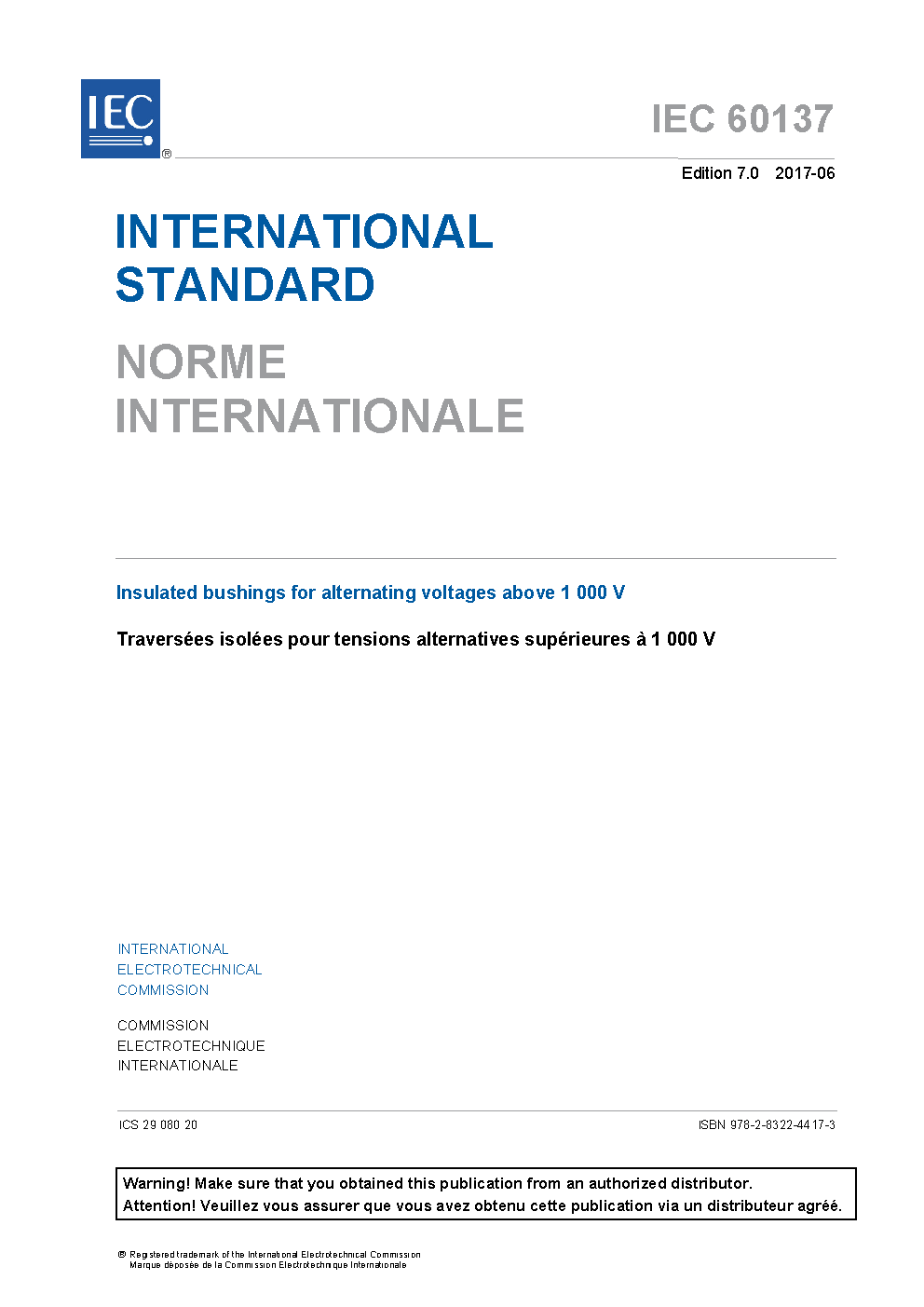
IEC 60137:2017
Insulated bushings for alternating voltages above 1000 V
 Preview
Summary
IEC 60137:2017 specifies the characteristics and tests for insulated bushings.
This standard is applicable to bushings, as defined in Clause 3, intended for use in electrical apparatus, machinery, transformers, switchgear and installations for three-phase alternating current systems, having highest voltage for equipment above 1 000 V and power frequencies of 15 Hz up to and including 60 Hz.
Subject to special agreement between purchaser and supplier, this standard may be applied, in part or as a whole, to the following:
- bushings used in other than three-phase systems;
- bushings for high-voltage direct current systems;
- bushings for testing transformers;
- bushings for capacitors.
Special requirements and tests for transformer bushings in this standard apply also to reactor bushings.
This standard is applicable to bushings made and sold separately. Bushings which are a part of an apparatus and which cannot be tested according to this standard should be tested with the apparatus of which they form part. This edition includes the following significant technical changes with respect to the previous edition:
- Resin-impregnated synthetic (RIS) bushings has been introduced.
- Bushings with Um = 1,1 kV, Um = 1100 kV and Um = 1200 kV have been introduced.
- Temperature rise testing has been included for liquid-insulated bushings according to clause to 3.4.
- Introducing dry lightning impulse testing as a routine test for all transformer bushings with Um > 72,5 kV.
- The altitude correction procedure has been revised ( > 1 000 m).
- An explanation about Very Fast Transient (VFT) phenomenon and its impact on bushings has been included.
The contents of the corrigendum of May 2018 have been included in this copy.
This standard is applicable to bushings, as defined in Clause 3, intended for use in electrical apparatus, machinery, transformers, switchgear and installations for three-phase alternating current systems, having highest voltage for equipment above 1 000 V and power frequencies of 15 Hz up to and including 60 Hz.
Subject to special agreement between purchaser and supplier, this standard may be applied, in part or as a whole, to the following:
- bushings used in other than three-phase systems;
- bushings for high-voltage direct current systems;
- bushings for testing transformers;
- bushings for capacitors.
Special requirements and tests for transformer bushings in this standard apply also to reactor bushings.
This standard is applicable to bushings made and sold separately. Bushings which are a part of an apparatus and which cannot be tested according to this standard should be tested with the apparatus of which they form part. This edition includes the following significant technical changes with respect to the previous edition:
- Resin-impregnated synthetic (RIS) bushings has been introduced.
- Bushings with Um = 1,1 kV, Um = 1100 kV and Um = 1200 kV have been introduced.
- Temperature rise testing has been included for liquid-insulated bushings according to clause to 3.4.
- Introducing dry lightning impulse testing as a routine test for all transformer bushings with Um > 72,5 kV.
- The altitude correction procedure has been revised ( > 1 000 m).
- An explanation about Very Fast Transient (VFT) phenomenon and its impact on bushings has been included.
The contents of the corrigendum of May 2018 have been included in this copy.
Technical characteristics
| Publisher | International Electrotechnical Commission (IEC) |
| Publication Date | 06/22/2017 |
| Release Date | 06/22/2017 |
| Edition | 7 |
| Page Count | 124 |
| EAN | --- |
| ISBN | --- |
| Weight (in grams) | --- |
Modified by
Previous versions
01/01/1962
Superseded
Historical
01/01/1973
Superseded
Historical
01/01/1984
Superseded
Historical
08/12/1995
Superseded
Historical
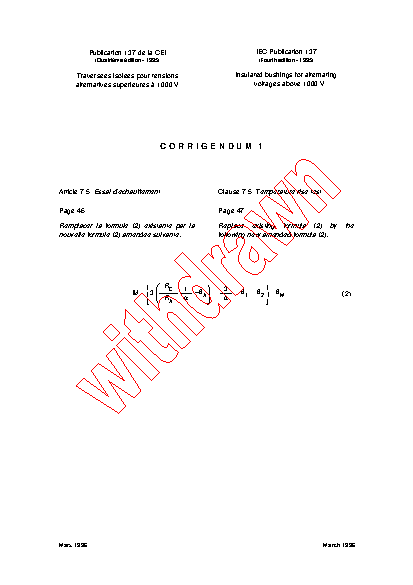
28/03/1996
Superseded
Historical
18/08/2003
Superseded
Historical
22/06/2017
Active
, Modified
Most Recent

07/05/2018
Active
Most Recent

25/07/2008
Superseded
Historical
No products.