ASTM F3811-26
 Preview
Summary
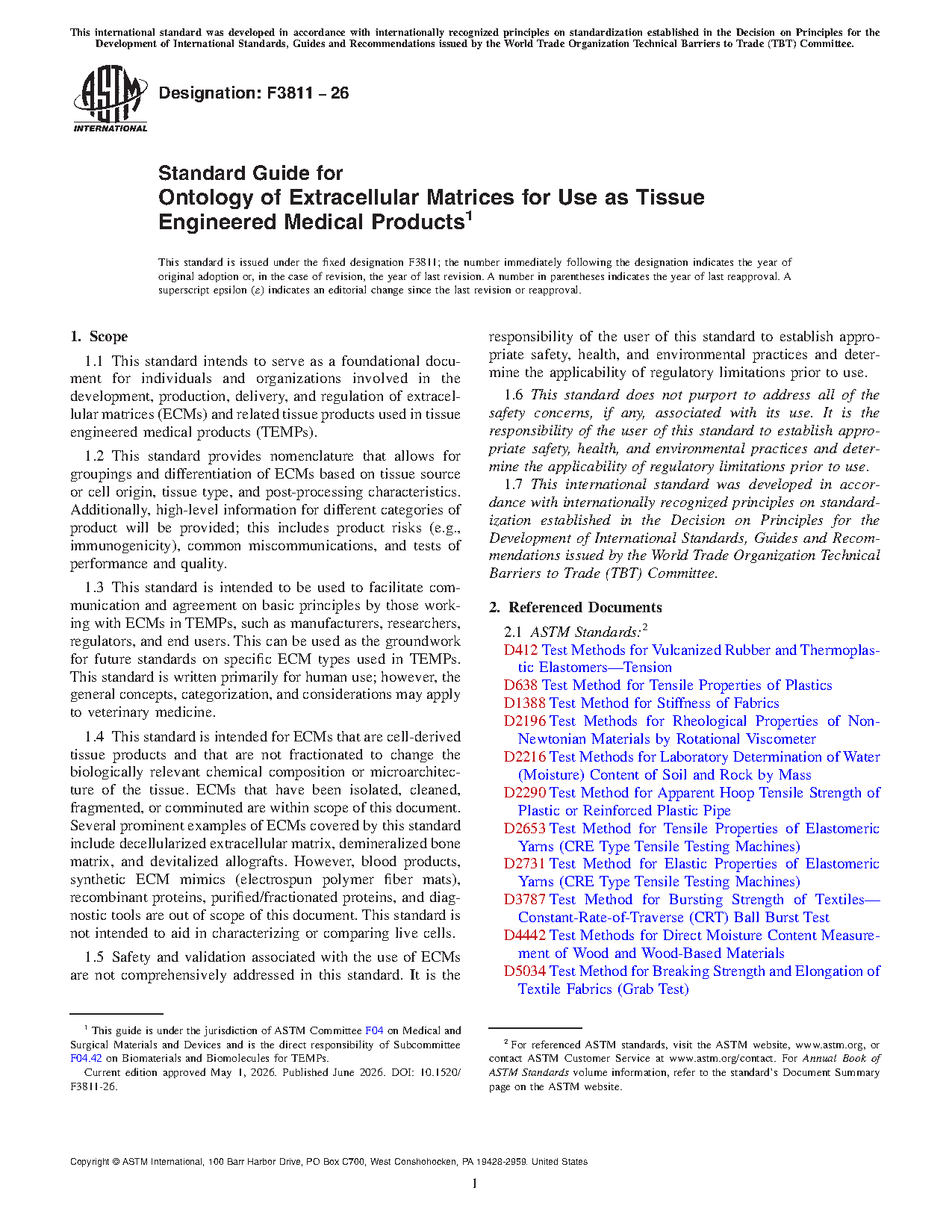
1.1 This standard intends to serve as a foundational document for individuals and organizations involved in the development, production, delivery, and regulation of extracellular matrices (ECMs) and related tissue products used in tissue engineered medical products (TEMPs).
1.2 This standard provides nomenclature that allows for groupings and differentiation of ECMs based on tissue source or cell origin, tissue type, and post-processing characteristics. Additionally, high-level information for different categories of product will be provided; this includes product risks (e.g., immunogenicity), common miscommunications, and tests of performance and quality.
1.3 This standard is intended to be used to facilitate communication and agreement on basic principles by those working with ECMs in TEMPs, such as manufacturers, researchers, regulators, and end users. This can be used as the groundwork for future standards on specific ECM types used in TEMPs. This standard is written primarily for human use; however, the general concepts, categorization, and considerations may apply to veterinary medicine.
1.4 This standard is intended for ECMs that are cell-derived tissue products and that are not fractionated to change the biologically relevant chemical composition or microarchitecture of the tissue. ECMs that have been isolated, cleaned, fragmented, or comminuted are within scope of this document. Several prominent examples of ECMs covered by this standard include decellularized extracellular matrix, demineralized bone matrix, and devitalized allografts. However, blood products, synthetic ECM mimics (electrospun polymer fiber mats), recombinant proteins, purified/fractionated proteins, and diagnostic tools are out of scope of this document. This standard is not intended to aid in characterizing or comparing live cells.
1.5 Safety and validation associated with the use of ECMs are not comprehensively addressed in this standard. It is the responsibility of the user of this standard to establish appropriate safety, health, and environmental practices and determine the applicability of regulatory limitations prior to use.
1.6 This standard does not purport to address all of the safety concerns, if any, associated with its use. It is the responsibility of the user of this standard to establish appropriate safety, health, and environmental practices and determine the applicability of regulatory limitations prior to use.
1.7 This international standard was developed in accordance with internationally recognized principles on standardization established in the Decision on Principles for the Development of International Standards, Guides and Recommendations issued by the World Trade Organization Technical Barriers to Trade (TBT) Committee.
Significance and Use:
3.1 The frequency of use of ECM products has gradually increased in the 21st century, as has the range of available products and applications as well as the opportunity for variable patient outcomes across these factors. Patient outcomes may be affected by multiple attributes, both related to a product’s ECM source and the processing used to create the end product. A standardized framework of these attributes can guide producers in best practices within any subset and aid in the comparison of similar products.
3.2 In addition, a standardized ontology would substantially improve communication between stakeholders and minimize confusion.
3.3 While ECM medical products comprise a subset of TEMPs, the cell or tissue source of the material and processing steps can vary substantially. As a result, it is difficult to compare ECM products or make reliable recommendations with respect to biological or chemical risks, or quantitative characterization of chemical composition or microstructural organization. This document provides a multi-factor scheme for characterizing ECM medical products according to the attributes most likely to enable meaningful groupings and comparisons.
3.4 Section 4 guides the categorization of ECM products based on the material source. Section 5 provides a basis for categorization based on final product attributes that reflect the effects of processing the source material into the product.
3.5 While products with a significant live cellular function are not the focus of this guide, the guide is still applicable to characterizing the ECM in products that contain live cells. The user is expected to use expert judgement in appropriately applying the ontological framework provided in this guide to the ECM component or to the whole product.
Technical characteristics
| Publisher | American Society for Testing and Materials (ASTM International) |
| Publication Date | 05/01/2026 |
| Collection | |
| Page Count | 13 |
| EAN | --- |
| ISBN | --- |
| Weight (in grams) | --- |
Previous versions
Collections list