ASTM F3256-25
 Preview
Summary
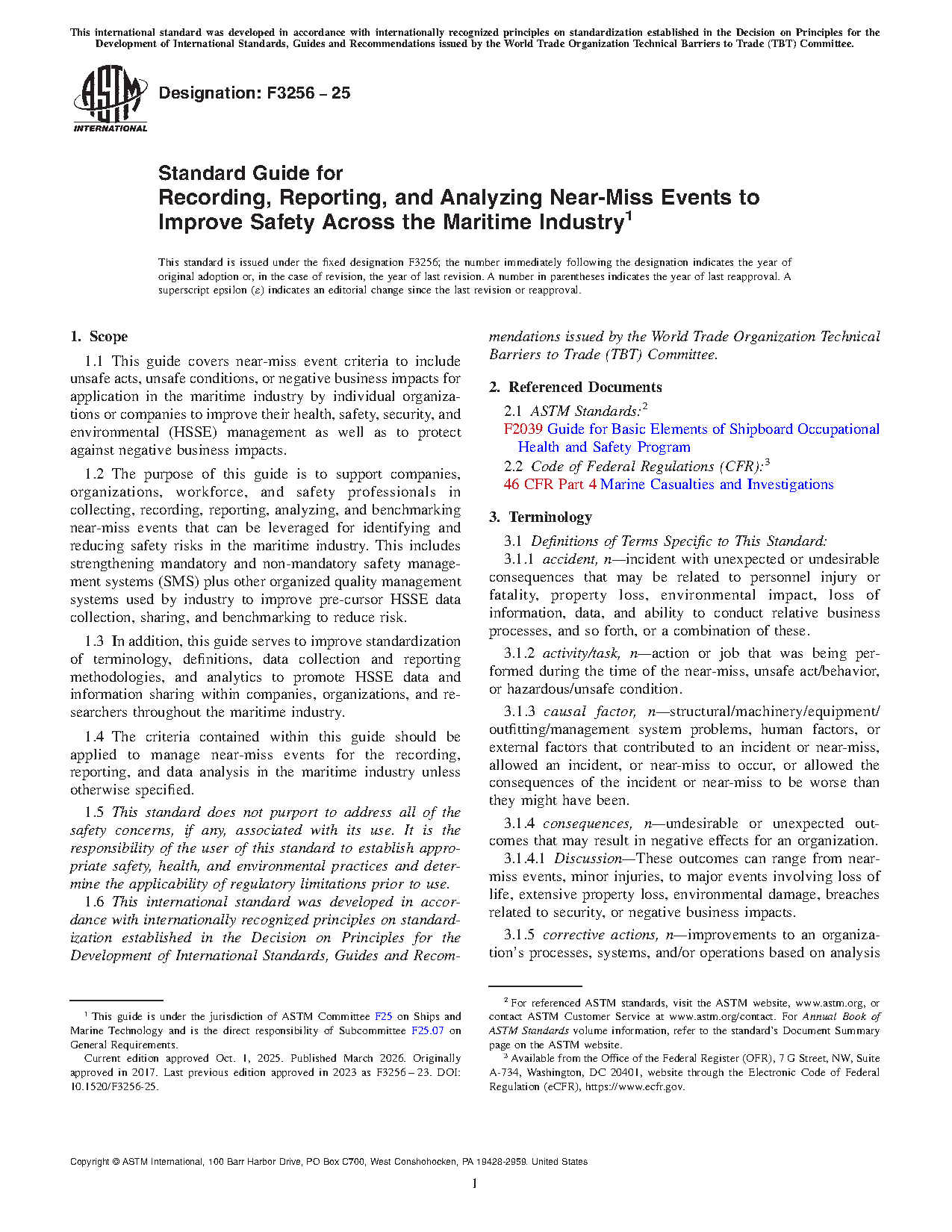
1.1 This guide covers near-miss event criteria to include unsafe acts, unsafe conditions, or negative business impacts for application in the maritime industry by individual organizations or companies to improve their health, safety, security, and environmental (HSSE) management as well as to protect against negative business impacts.
1.2 The purpose of this guide is to support companies, organizations, workforce, and safety professionals in collecting, recording, reporting, analyzing, and benchmarking near-miss events that can be leveraged for identifying and reducing safety risks in the maritime industry. This includes strengthening mandatory and non-mandatory safety management systems (SMS) plus other organized quality management systems used by industry to improve pre-cursor HSSE data collection, sharing, and benchmarking to reduce risk.
1.3 In addition, this guide serves to improve standardization of terminology, definitions, data collection and reporting methodologies, and analytics to promote HSSE data and information sharing within companies, organizations, and researchers throughout the maritime industry.
1.4 The criteria contained within this guide should be applied to manage near-miss events for the recording, reporting, and data analysis in the maritime industry unless otherwise specified.
1.5 This standard does not purport to address all of the safety concerns, if any, associated with its use. It is the responsibility of the user of this standard to establish appropriate safety, health, and environmental practices and determine the applicability of regulatory limitations prior to use.
1.6 This international standard was developed in accordance with internationally recognized principles on standardization established in the Decision on Principles for the Development of International Standards, Guides and Recommendations issued by the World Trade Organization Technical Barriers to Trade (TBT) Committee.
Significance and Use:
4.1 The objective of this near-miss recording and reporting guide is to support companies, organizations, workforce, and safety professionals in the collection, recording, reporting, analysis, and benchmarking of near-miss safety related events that can be leveraged for identifying and reducing safety risks in the maritime industry. Furthermore, it is envisioned that this guide will be used to promote standardization of near-miss terminology, definitions, data recording, reporting, and analytics to encourage safety data and information sharing within and between companies, organizations, researchers, and throughout the maritime industry.
4.1.1 The maritime industry has not consistently applied a harmonized definition of a near-miss or a structured near-miss reporting methodology. This makes providing industry wide safety related lessons learned, trending, and benchmarking challenging.
4.1.2 A functioning comprehensive near-miss reporting, follow-up investigation, and corrective action system supports compliance with the IMOs requirement for near-miss reporting as outlined within the ISM Code. The ISM Code mandates that shipping companies establish procedures to report “hazardous occurrences,” including near-misses, to enable investigation and analysis to prevent future incidents; essentially, all near-misses should be reported and investigated as appropriate to the level of risk of the near-miss event to improve safety on board ships. This guide supports those companies.
4.1.3 For maritime operating companies that are not required to comply with the ISM Code, the direction and assistance in this guide is provided for the voluntary establishment, implementation, and administration of near-miss reporting and analysis programs for continual safety improvement, which will reduce the number of incidents and operating costs onboard their vessels.
4.2 Importance of Near-Miss Reporting:
4.2.1 Most accidents/incidents are preceded by a chain of events, circumstances, acts, or conditions. If any of these events, circumstances, acts, or conditions had transpired another way, at another time, or had been corrected, the accident/incident may have been avoided. Reporting near-misses can play an important role in learning and procedural improvement with the intent to prevent accidents and their potential serious consequences or the reoccurrence of the event.
4.2.2 Near-miss recording and reporting provides information that can be used to improve any safety system, often complementing other safety system components such as accident/incident investigations, hazard analyses, safety reporting, prioritizing, root cause analysis, solution identification, communication, identifying corrective actions, sharing lessons learned, leading safety indicator analyses, or safety culture enhancement. In addition, in terms of human life and property damage, near-miss recording, reporting, and analyses are low-cost learning tools to support training and prevention of reoccurrence as well as to provide a new data source on what may work to break the chain of events before an accident occurs. Finally, near-miss analyses may provide key data that can prevent low-probability, high-consequence accidents by supporting safety barrier improvements or providing safer alternatives.
4.3 Barriers to Near-Miss Reporting—It is generally agreed that effective near-miss reporting can reduce hazardous conditions and situations in the workplace resulting in a reduction in accidents or at least provide an opportunity for hazard identification and abatement. However, significant challenges and obstacles to implementing near-miss recording/reporting systems remain. The barriers can be related to the employees and management as well as outside influences. These are more prevalent in an organization that has a blame-oriented culture. They can lead to under-reporting incidents in the maritime industry. Common practices that can help overcome near-miss recording and reporting barriers include, but are not limited to:
4.3.1 Management should provide unwavering support for near-miss recording and reporting. This includes providing adequate time for the employee to complete the near-miss report. Additionally, this includes any financial support or support from external experts, if necessary, to correct potentially hazardous conditions. Management commitment to safety has a positive effect on reporting, while under-reporting has been linked to lack of management commitment to safety.
4.3.2 Management should not be overly fearful of legal liability as to damper the near-miss recording and reporting process. When deciding to formalize a near-miss reporting system, organizations have both legitimate and unsubstantiated fears of liability and recrimination. Near-miss recording and reporting should be viewed by all stakeholders (companies, legislators, enforcement agencies, and the legal system) as one of the most effective ways to identify hazards and reduce accidents/incidents and not used for recrimination of any type. As noted in 4.1.2, the IMO requires shipping companies to include near-miss recording and reporting within their SMS.
4.3.3 Employees should not fear any disciplinary action, peer teasing, or supervisory belittling. A means of anonymous, confidential, and secure reporting should exist, and a positive, no-blame near-miss recording and reporting culture needs to be nurtured. This includes security and cybersecurity for data systems that support the organization’s near-miss process.
4.3.4 Employees should be fully engaged in the development, implementation, and operation of the company’s near-miss recording and reporting system.
4.3.5 Employees should believe that their near-miss reports are being followed up. If the reports are not actively followed up and there is not clear communication between ship and shore, near-miss reporting efforts will fail.
4.3.6 Employees should be adequately trained in the near-miss recording and reporting process and familiar with its goals and objectives. Employees should be trained how to report near-misses, what constitutes a near-miss, and the benefits of near-miss recording and reporting. Training employees properly will ensure that reports on near-miss events are as comprehensive and complete as possible.
4.3.7 Employees should be motivated to report near-misses. This could include productive incentives for reporting. Participation in near-miss recording and reporting cuts across all levels of an organization, and management should fully support and encourage near-miss reporting through their words and actions.
4.3.8 The near-miss recording and reporting process should be efficient and not overly time consuming. Near-miss reporting forms and tools should be automated and as comprehensive, as possible, to be easily completed, easily available, easily submitted, easily reviewed, and lessons learned easily disseminated.
4.4 Harmonization of Near-Miss Data Collection and Reporting Processes—Near-miss recording, reporting, data collection, and associated analysis and benchmarking vary widely across the maritime industry. Not only does this create a challenge for industry-wide trending and benchmarking, but it also requires significant company resources and infrastructure to support near-miss safety initiatives. Leveraging this guide and applying it in safety data recording and reporting efforts will lead to better harmonization of near-miss data reporting efforts across industry as well as improve organizational efficiencies that will reduce the resources required to achieve the desired benefit.
4.5 Automation of Near-Miss Data Recording and Reporting Processes—While most maritime companies use computer technology to record and report near-misses, administrative workload is still a challenge. Computer technology (automated data collection forms, mobile apps, audio recording capabilities for narrative development, and so forth) and associated tools are essential in the administrative process for effective near-miss reporting and should be used throughout the process to improve efficiency, consistency, and reduce administrative burdens and barriers to reporting.
4.6 Quotas for Near-Miss Data Recording and Reporting—Some maritime companies require near-miss quotas, while others do not. If seafarers are expected to complete a minimum number of near-miss reports in a given timeframe, processes should be in place that prevent erroneous or frivolous near-miss recording and reporting.
Technical characteristics
| Publisher | American Society for Testing and Materials (ASTM International) |
| Publication Date | 10/01/2025 |
| Collection | |
| Page Count | 19 |
| Themes | General standards related to shipbuilding and marine structures |
| EAN | --- |
| ISBN | --- |
| Weight (in grams) | --- |
Replaces
Previous versions

Collections list