ASTM E3436-26
 Preview
Summary
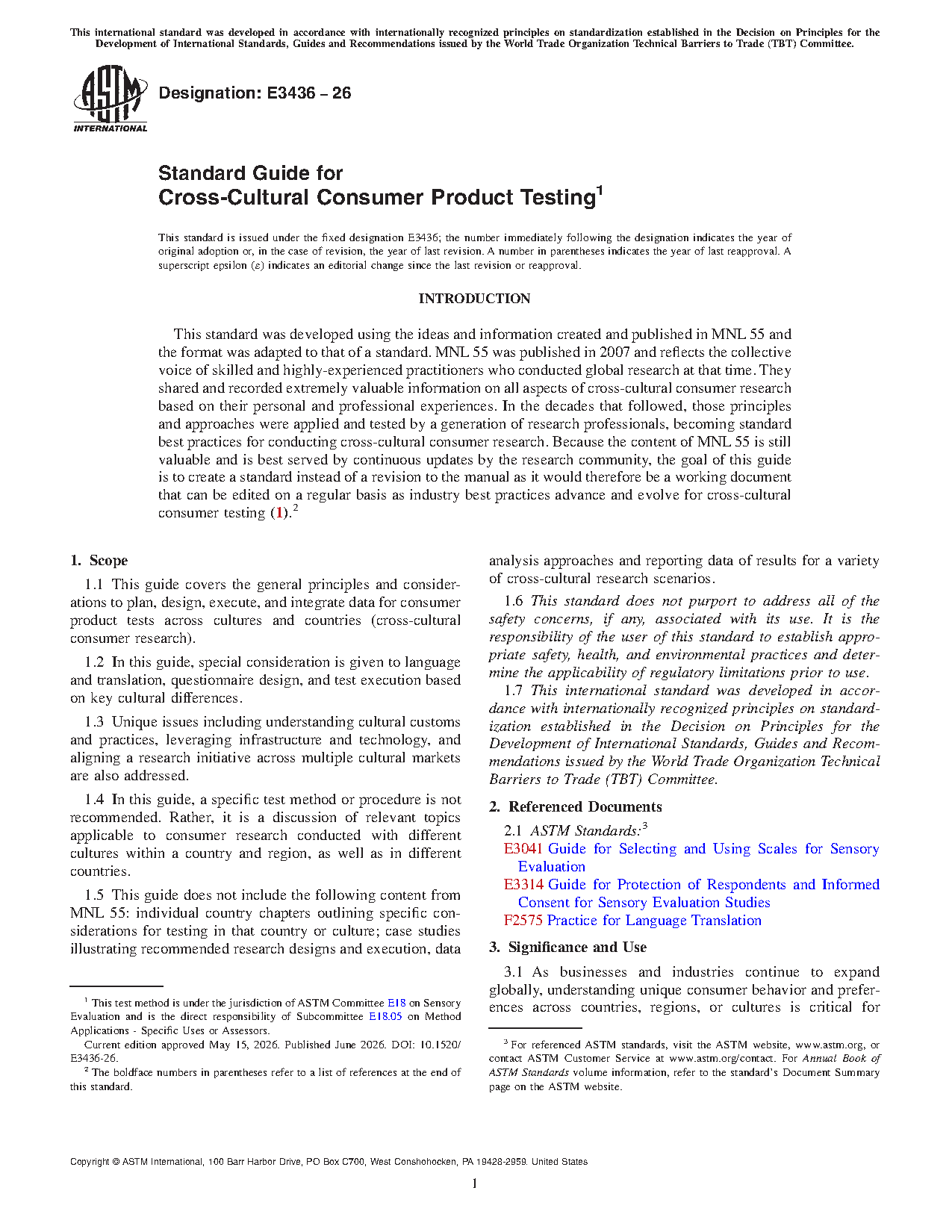
1.1 This guide covers the general principles and considerations to plan, design, execute, and integrate data for consumer product tests across cultures and countries (cross-cultural consumer research).
1.2 In this guide, special consideration is given to language and translation, questionnaire design, and test execution based on key cultural differences.
1.3 Unique issues including understanding cultural customs and practices, leveraging infrastructure and technology, and aligning a research initiative across multiple cultural markets are also addressed.
1.4 In this guide, a specific test method or procedure is not recommended. Rather, it is a discussion of relevant topics applicable to consumer research conducted with different cultures within a country and region, as well as in different countries.
1.5 This guide does not include the following content from MNL 55: individual country chapters outlining specific considerations for testing in that country or culture; case studies illustrating recommended research designs and execution, data analysis approaches and reporting data of results for a variety of cross-cultural research scenarios.
1.6 This standard does not purport to address all of the safety concerns, if any, associated with its use. It is the responsibility of the user of this standard to establish appropriate safety, health, and environmental practices and determine the applicability of regulatory limitations prior to use.
1.7 This international standard was developed in accordance with internationally recognized principles on standardization established in the Decision on Principles for the Development of International Standards, Guides and Recommendations issued by the World Trade Organization Technical Barriers to Trade (TBT) Committee.
Significance and Use:
3.1 As businesses and industries continue to expand globally, understanding unique consumer behavior and preferences across countries, regions, or cultures is critical for success. Implementing best practices, to design research and collect data and insights within and across countries or cultures, is critical to being sensitive and intentional about recognizing, interpreting, and reacting correctly to people, incidences, or situations that are culturally different (2).
3.1.1 Dietary, hereditary, cultural, religious, and environmental conditions, for example, influence consumer responses.
3.1.2 Even within a country, significant cultural communities or ethnic groups represent growing market niches that deserve research focus.
3.2 Making appropriate business decisions based on cross-cultural consumer research requires designing and executing studies with consideration to these unique characteristics across target consumer populations.
3.3 To design and conduct cross-cultural research studies effectively, sensory/consumer scientists and market researchers should understand the cultural nuances in the local consumer populations of interest.
3.3.1 Successful research design includes operating within regional cultural norms and legal frameworks, and using appropriate methods for collecting cross-cultural consumer data. In many cases, collaborating and communicating with local consumer market research agencies provides essential cultural understanding to facilitate test planning and execution.
3.4 Differences in perceptions and preferences across cultures are recognized (to name a few, see Refs (3-8)). Effects of subculture within a country or region on attitudes and values are also observed.
3.4.1 The impact of culture also drives differences in consumer habits and use of consumer products for everyday tasks, such as cleaning and personal (health) care, which can influence consumer preference and attitudes.
3.4.2 While cross-cultural differences that pertain to geopolitical boundaries are the typical focal point, commonalities among different countries within a region, such as the Gulf Cooperation Council (GCC) and Australasia, suggest that consumer segmentation may be a useful strategy in these areas of the world. Consequently, international market segmentation that takes advantage of commonalities among countries within a region may enhance marketing efficiency. To the extent that such a strategy is followed, testing in all these countries may not be necessary.
3.4.3 Cultures can differ in their philosophy of community (collectivist) versus individual (individualistic), which impacts consumer choices and liking of products. For example, collectivist cultures, like Korea, Japan, and China, consider the impact of branding as it relates to a group or community’s image, whereas individualistic cultures like the United States, the United Kingdom, and Australia, consider branding from the viewpoint of the individual (9).
3.5 In this guide, the challenges encountered in conducting consumer research in cultures or markets not native to the researcher are illustrated and approaches to avoid testing mistakes are recommended. Careful considerations, beyond what is typical for home markets, on procedural issues, such as scale orientation, experimental design, language translation, products in the market, recruiting, and protocols, will help to ensure the validity and success of global test results.
Technical characteristics
| Publisher | American Society for Testing and Materials (ASTM International) |
| Publication Date | 05/15/2026 |
| Collection | |
| Page Count | 14 |
| EAN | --- |
| ISBN | --- |
| Weight (in grams) | --- |
Previous versions
Collections list