ASTM E3149-26
 Preview
Summary
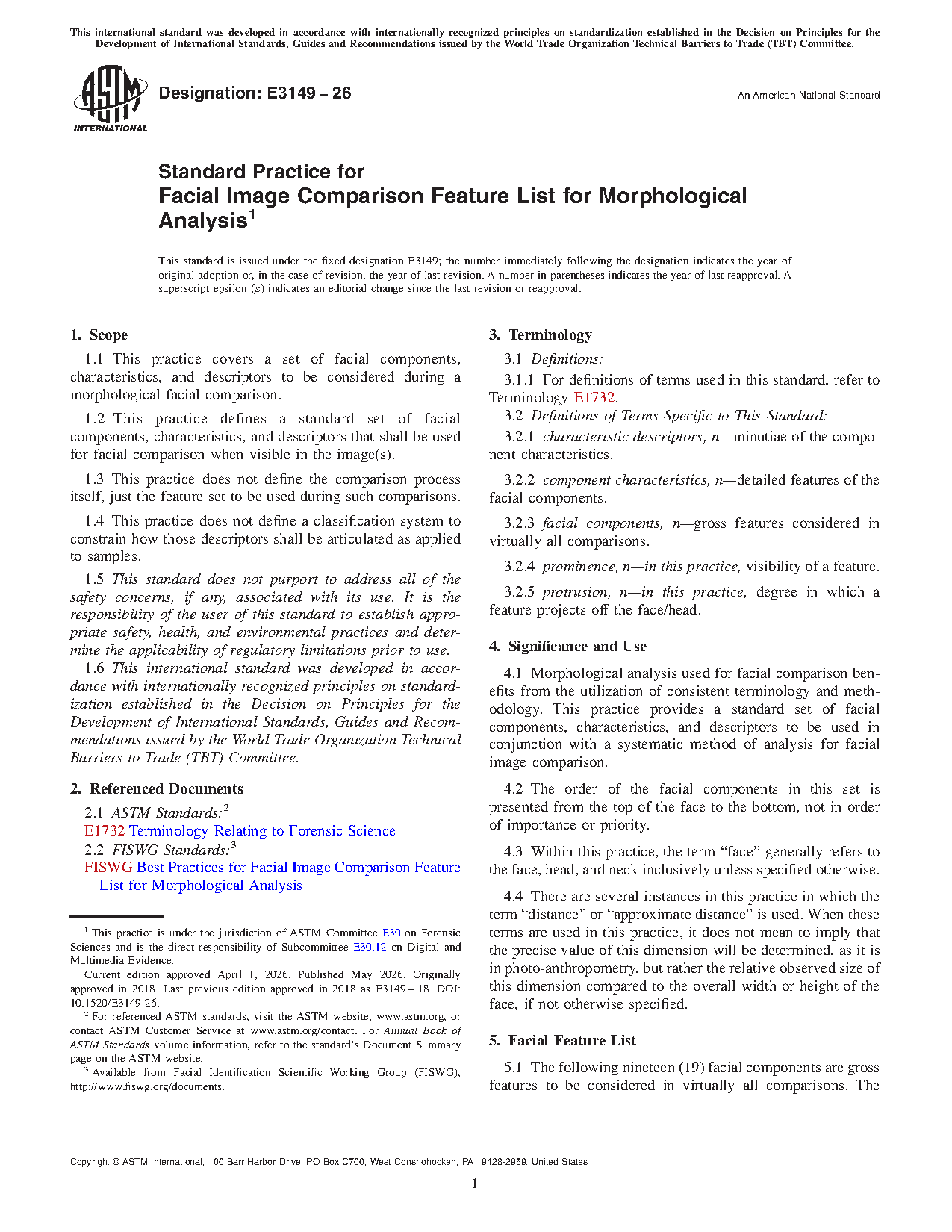
1.1 This practice covers a set of facial components, characteristics, and descriptors to be considered during a morphological facial comparison.
1.2 This practice defines a standard set of facial components, characteristics, and descriptors that shall be used for facial comparison when visible in the image(s).
1.3 This practice does not define the comparison process itself, just the feature set to be used during such comparisons.
1.4 This practice does not define a classification system to constrain how those descriptors shall be articulated as applied to samples.
1.5 This standard does not purport to address all of the safety concerns, if any, associated with its use. It is the responsibility of the user of this standard to establish appropriate safety, health, and environmental practices and determine the applicability of regulatory limitations prior to use.
1.6 This international standard was developed in accordance with internationally recognized principles on standardization established in the Decision on Principles for the Development of International Standards, Guides and Recommendations issued by the World Trade Organization Technical Barriers to Trade (TBT) Committee.
Significance and Use:
4.1 Morphological analysis used for facial comparison benefits from the utilization of consistent terminology and methodology. This practice provides a standard set of facial components, characteristics, and descriptors to be used in conjunction with a systematic method of analysis for facial image comparison.
4.2 The order of the facial components in this set is presented from the top of the face to the bottom, not in order of importance or priority.
4.3 Within this practice, the term “face” generally refers to the face, head, and neck inclusively unless specified otherwise.
4.4 There are several instances in this practice in which the term “distance” or “approximate distance” is used. When these terms are used in this practice, it does not mean to imply that the precise value of this dimension will be determined, as it is in photo-anthropometry, but rather the relative observed size of this dimension compared to the overall width or height of the face, if not otherwise specified.
Technical characteristics
| Publisher | American Society for Testing and Materials (ASTM International) |
| Publication Date | 04/01/2026 |
| Collection | |
| Page Count | 28 |
| Themes | Biometrics |
| EAN | --- |
| ISBN | --- |
| Weight (in grams) | --- |
Replaces
Previous versions
Collections list