
ASTM E1817-26
 Preview
Summary
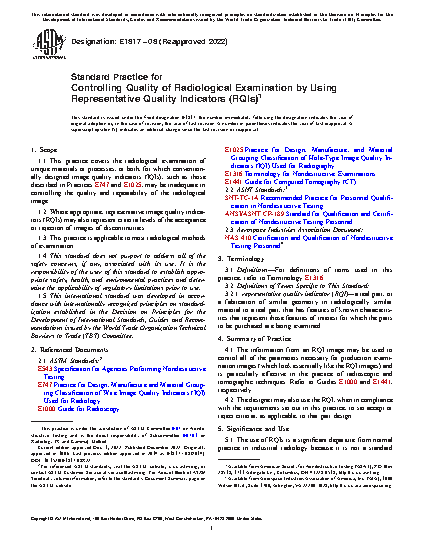
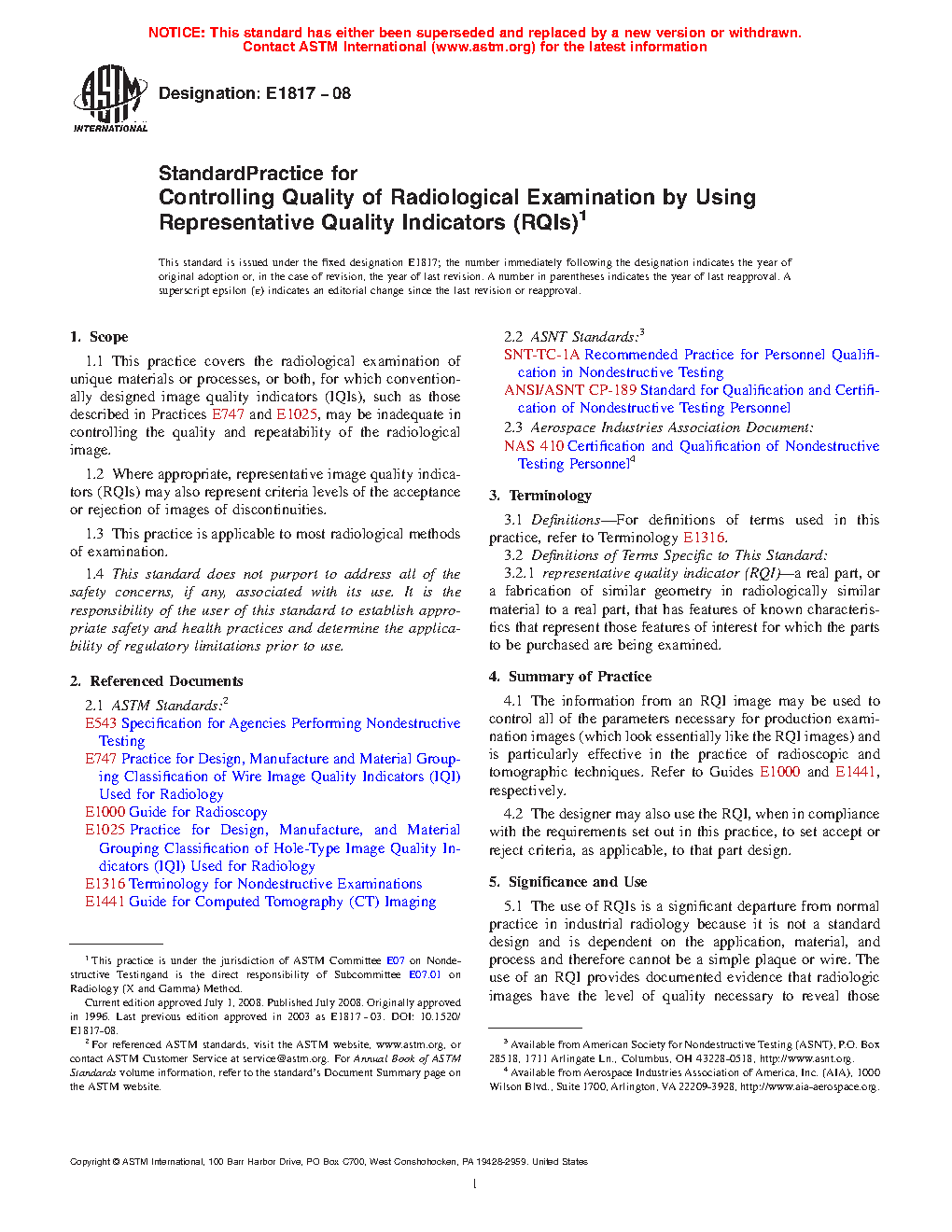
1.1 This practice covers the radiographic examination of unique materials or processes, or both, for which conventionally designed image quality indicators (IQIs), such as those described in Practices E747, E2002, and E1025, and Test Method E1695 may be inadequate in controlling the quality and repeatability of the radiographic image.
1.2 Where appropriate, representative image quality indicators (RQIs) may also represent criteria levels of the acceptance or rejection of images of discontinuities.
1.3 This practice is applicable to most radiographic techniques of examination. If CT (computed tomography) is being used to examine materials or processes and conventional IQIs are insufficient for quality control, this practice may be applicable and useful in ensuring the quality and repeatability of the resulting CT images.
1.4 This standard does not purport to address all of the safety concerns, if any, associated with its use. It is the responsibility of the user of this standard to establish appropriate safety, health, and environmental practices and determine the applicability of regulatory limitations prior to use.
1.5 This international standard was developed in accordance with internationally recognized principles on standardization established in the Decision on Principles for the Development of International Standards, Guides and Recommendations issued by the World Trade Organization Technical Barriers to Trade (TBT) Committee.
Significance and Use:
5.1 The use of RQIs is a significant departure from normal practice in industrial radiography because it is not a standard design and is dependent on the application, material, and process and therefore cannot be a simple plaque or wire. The use of an RQI provides documented evidence that radiographic images have the level of quality necessary to reveal those nonconformances for which the parts are being examined by ensuring adequate spatial resolution and contrast sensitivity in the areas of interest.
5.2 Where conventional IQIs conforming to Practices E747, E2002, or E1025 can be used effectively, those practices should be followed.
5.3 The RQI is used to validate the radiographic acquisition (2D/3D) and to control the process. The process of utilizing the RQI shall be documented in the technical plan.
5.4 The RQI shall be used to verify capability, acquisition stability, and technique development.
5.4.1 Verify the system capability to perform its intended function effectively and consistently.
5.4.2 Acquisition stability ensures consistency and reliability of the radiographic acquisition system (2D/3D).
5.4.3 Technique development, using the RQI to optimize the acquisition process.
Technical characteristics
| Publisher | American Society for Testing and Materials (ASTM International) |
| Publication Date | 02/01/2026 |
| Collection | |
| Page Count | 3 |
| Themes | Non-destructive testing of metals |
| EAN | --- |
| ISBN | --- |
| Weight (in grams) | --- |
Replaces
Previous versions
Collections list