ASTM D8675-26
 Preview
Summary
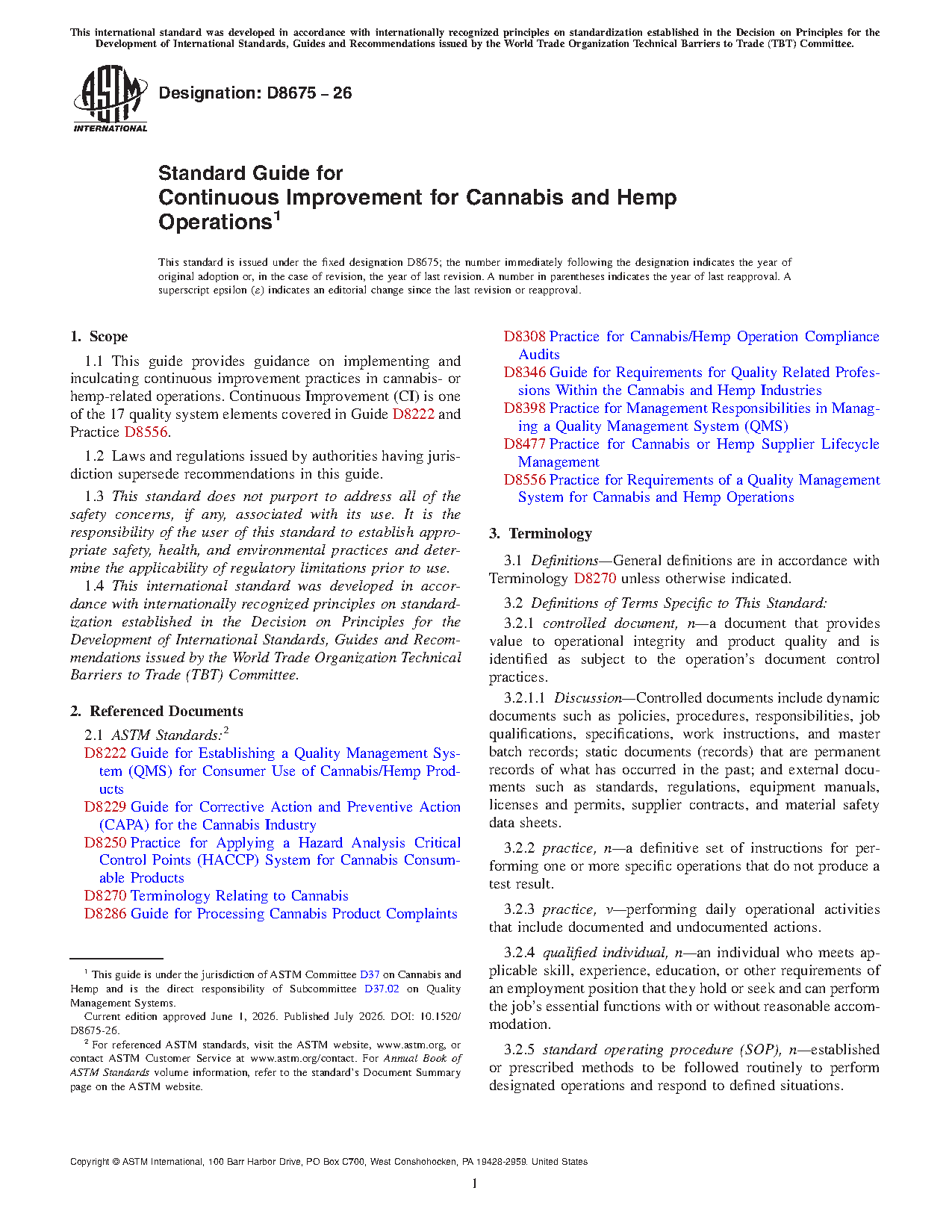
1.1 This guide provides guidance on implementing and inculcating continuous improvement practices in cannabis- or hemp-related operations. Continuous Improvement (CI) is one of the 17 quality system elements covered in Guide D8222 and Practice D8556.
1.2 Laws and regulations issued by authorities having jurisdiction supersede recommendations in this guide.
1.3 This standard does not purport to address all of the safety concerns, if any, associated with its use. It is the responsibility of the user of this standard to establish appropriate safety, health, and environmental practices and determine the applicability of regulatory limitations prior to use.
1.4 This international standard was developed in accordance with internationally recognized principles on standardization established in the Decision on Principles for the Development of International Standards, Guides and Recommendations issued by the World Trade Organization Technical Barriers to Trade (TBT) Committee.
Significance and Use:
5.1 Significance of this Guide:
5.1.1 Continuous improvement (CI) is a fundamental element of an operation’s quality management efforts. When CI is practiced daily from the top down through the organization, the other elements of quality management fall into place.
5.1.2 CI principles are not only a foundation for good agricultural and collection practices (GACP) and good manufacturing practices (GMP), but should also be applied to all processes and systems from top management down.
5.2 Using this Guide:
5.2.1 Section 6 provides a basic CI process. There is no specific sequence for implementing CI practices. CI is an iterative process. Use this standard as a guide to embed CI thinking throughout the entire organization.
5.2.1.1 Do not attempt to perfect the implementation of one element before moving on to another. Implement initial components for each element and expect to learn more as other elements are addressed and continuously improved. Recognize that progress on the different elements will vary. One may be considered an industry best practice, while another is struggling.
5.2.1.2 Do not underestimate the importance of top management’s responsibility to lead by example and inculcate process thinking and CI throughout the organization. Management’s actions, not words, banners, or policies, drive the organization’s culture. This leadership is essential to establishing a quality culture, an effective quality management system, and a consistently improving operation.
5.2.2 Section 7 includes each CI requirement from Practice D8556. The requirement is displayed in italics. It is followed by guidance to help implement the requirement to establish long-lasting, CI practices.
5.2.3 This guide includes an annex and three appendixes to support implementation.
5.2.3.1 The annex presents key concepts and principles that form the foundation of CI.
5.2.3.2 Appendix X1 provides implementation models and methods commonly used to structure and guide CI implementation within an organization.
5.2.3.3 Appendix X2 provides examples of commonly used CI methods and tools that support process analysis, measurement, and improvement.
5.2.3.4 Appendix X3 provides examples of team development and human-factor tools that support effective communication, leadership, and collaboration.
5.2.4 Many CI tools are easy to learn and can be applied immediately, while others may require more in-depth study or guided instruction. Some tools are components of broader frameworks.
5.2.5 The key is for each organization to build and maintain a collection of tools that fit its needs, culture, and scale. Start with a few simple tools that support the organization's CI goals and expand over time as staff members, including management, become more confident and experienced.
5.2.6 Resources for learning these tools are widely available through online materials, in-person and virtual training, and external consultants. Documentation on how tools are selected, applied, and adapted within the organization should be maintained. This helps preserve institutional knowledge and ensures continuity when staffing changes occur.
5.2.7 Include CI tools and their uses in staff onboarding and regular job training. When everyone understands the available tools and when to use them, the organization is better equipped to solve problems, make improvements, and sustain progress over time.
5.2.8 Like many skills, such as roller skating, bike riding, surfing, and skiing, CI may initially feel awkward and unfamiliar. With time and practice, it becomes second nature, a routine, and an integrated way of managing and performing work. CI is not a straight, steady climb; the path includes ups and downs, occasional setbacks, and sometimes restarts. What matters is commitment and ongoing practice.
Technical characteristics
| Publisher | American Society for Testing and Materials (ASTM International) |
| Publication Date | 06/01/2026 |
| Collection | |
| Page Count | 11 |
| EAN | --- |
| ISBN | --- |
| Weight (in grams) | --- |
Previous versions
Collections list