ASTM D8655-26
 Preview
Summary
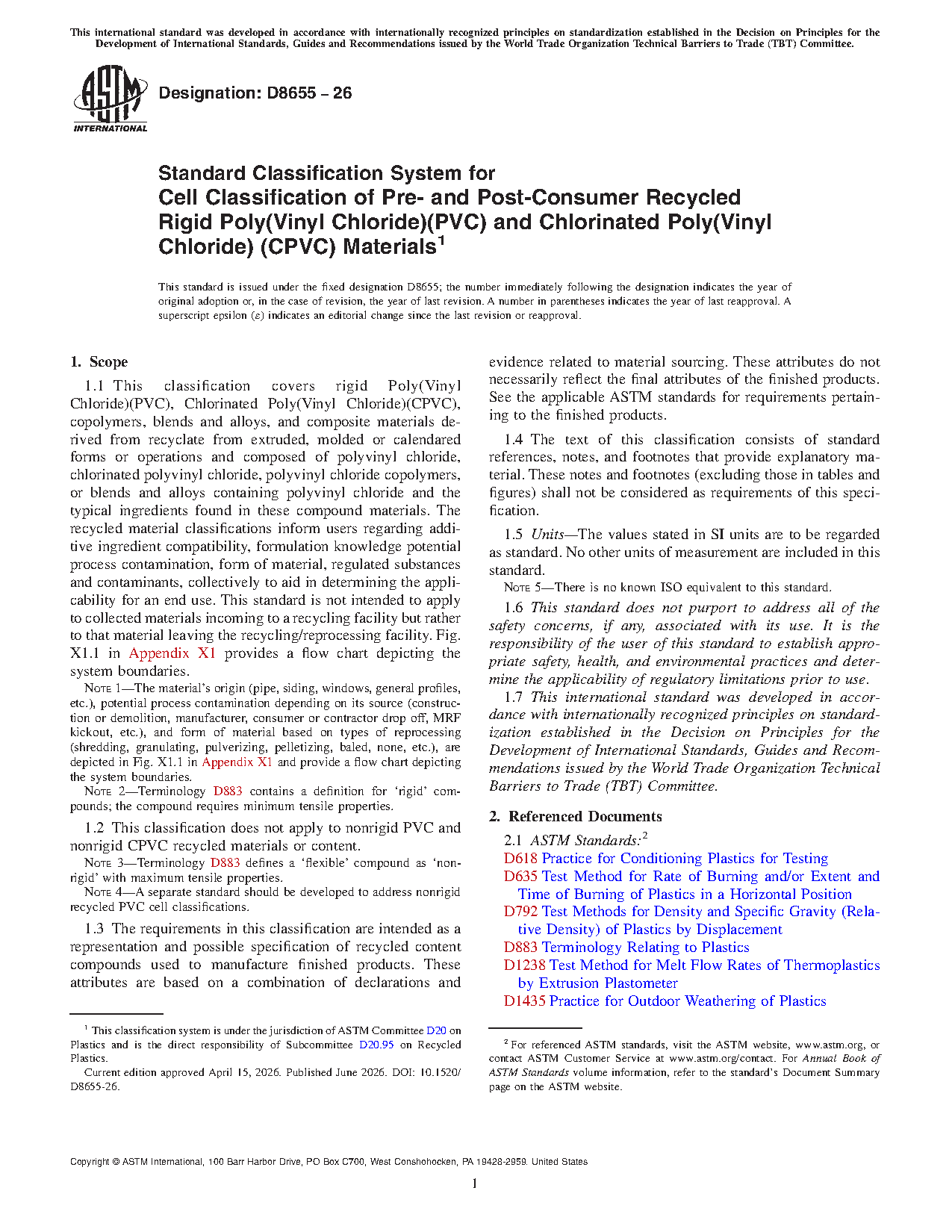
1.1 This classification covers rigid Poly(Vinyl Chloride)(PVC), Chlorinated Poly(Vinyl Chloride)(CPVC), copolymers, blends and alloys, and composite materials derived from recyclate from extruded, molded or calendared forms or operations and composed of polyvinyl chloride, chlorinated polyvinyl chloride, polyvinyl chloride copolymers, or blends and alloys containing polyvinyl chloride and the typical ingredients found in these compound materials. The recycled material classifications inform users regarding additive ingredient compatibility, formulation knowledge potential process contamination, form of material, regulated substances and contaminants, collectively to aid in determining the applicability for an end use. This standard is not intended to apply to collected materials incoming to a recycling facility but rather to that material leaving the recycling/reprocessing facility. Fig. X1.1 in Appendix X1 provides a flow chart depicting the system boundaries.
Note 1: The material’s origin (pipe, siding, windows, general profiles, etc.), potential process contamination depending on its source (construction or demolition, manufacturer, consumer or contractor drop off, MRF kickout, etc.), and form of material based on types of reprocessing (shredding, granulating, pulverizing, pelletizing, baled, none, etc.), are depicted in Fig. X1.1 in Appendix X1 and provide a flow chart depicting the system boundaries.
Note 2: Terminology D883 contains a definition for ‘rigid’ compounds; the compound requires minimum tensile properties.
1.2 This classification does not apply to nonrigid PVC and nonrigid CPVC recycled materials or content.
Note 3: Terminology D883 defines a ‘flexible’ compound as ‘nonrigid’ with maximum tensile properties.
Note 4: A separate standard should be developed to address nonrigid recycled PVC cell classifications.
1.3 The requirements in this classification are intended as a representation and possible specification of recycled content compounds used to manufacture finished products. These attributes are based on a combination of declarations and evidence related to material sourcing. These attributes do not necessarily reflect the final attributes of the finished products. See the applicable ASTM standards for requirements pertaining to the finished products.
1.4 The text of this classification consists of standard references, notes, and footnotes that provide explanatory material. These notes and footnotes (excluding those in tables and figures) shall not be considered as requirements of this specification.
1.5 Units—The values stated in SI units are to be regarded as standard. No other units of measurement are included in this standard.
Note 5: There is no known ISO equivalent to this standard.
1.6 This standard does not purport to address all of the safety concerns, if any, associated with its use. It is the responsibility of the user of this standard to establish appropriate safety, health, and environmental practices and determine the applicability of regulatory limitations prior to use.
1.7 This international standard was developed in accordance with internationally recognized principles on standardization established in the Decision on Principles for the Development of International Standards, Guides and Recommendations issued by the World Trade Organization Technical Barriers to Trade (TBT) Committee.
Significance and Use:
4.1 While end-use product performance and durability remain critical for functionality, the focus on recycling rigid PVC products or components at their end of life needs to be intensified. Participants in the value chain (for example, material scientists, product designers, procurement, and sustainability personnel) need resources that include guidance regarding the use of recycled content in the produced material. This standard addresses the classification of materials produced using pre- and/or post-consumer content.
4.2 The use of this standard helps facilitate communication between supplier and processor. These outcomes are achieved in three ways:
4.2.1 Determining key attributes of pre- and post-consumer vinyl material by determining a cell classification;
4.2.2 Determining practical uses endpoints of pre- and post-consumer vinyl material;
4.2.3 Providing guidance for how to use the cell classification designation in a certificate of analysis suitable for pre- and post-consumer vinyl material.
Note 7: Recycled content minimums and/or effective end-of-life strategies help achieve broader sustainability goals such as resource conservation, as well as drive consumer preference. Lowering the carbon footprint of a PVC or CPVC product in most cases may enhance the sustainability of their respective industries. Reduced carbon intensity needs to be verified by objective evaluation, such as a comprehensive life cycle assessment (LCA). Formulators, product designers and procurement managers play a key role in achieving these outcomes.
4.3 This standard does not specify what is and is not allowed in recycling material and does not define required characteristics for any applications, which need to be covered in the specific product specifications.
4.4 In this standard, the term post-consumer refers to materials that otherwise would have been waste and that are reclaimed from products and components that have already served their intended end-use in consumer, commercial, or industrial applications, including from installation residuals, and does not include pre-consumer or post-industrial material.
Note 8: The inclusion of “commercial or industrial” in the context of “products and components” does not refer to pre-consumer or post-industrial scrap, but as an example it could refer to cooling tower fill at the end of its useful life, which would be collected as a post-consumer material.
4.5 In this standard, the terms pre-consumer or post-industrial refer to materials that otherwise would have been waste and that are reclaimed from manufacturing and other industrial processes, and products that have not served their intended end-use as a consumer item and have the potential to include trimmed materials, off-spec materials, overruns, obsolete inventories that are reprocessed, and does not include post-consumer material.
4.6 Some relevant references that provide useful information are the following standards: Test Method D635, Test Method D1238, Practice D1435, Practice D2538, Test Method D3364, Classification D5260, Guide D7209, Specification D7856, Test Method E84, and Guide F2577.
Technical characteristics
| Publisher | American Society for Testing and Materials (ASTM International) |
| Publication Date | 04/15/2026 |
| Collection | |
| Page Count | 8 |
| EAN | --- |
| ISBN | --- |
| Weight (in grams) | --- |
Previous versions
Collections list