ASTM D8605/D8605M-26
 Preview
Summary
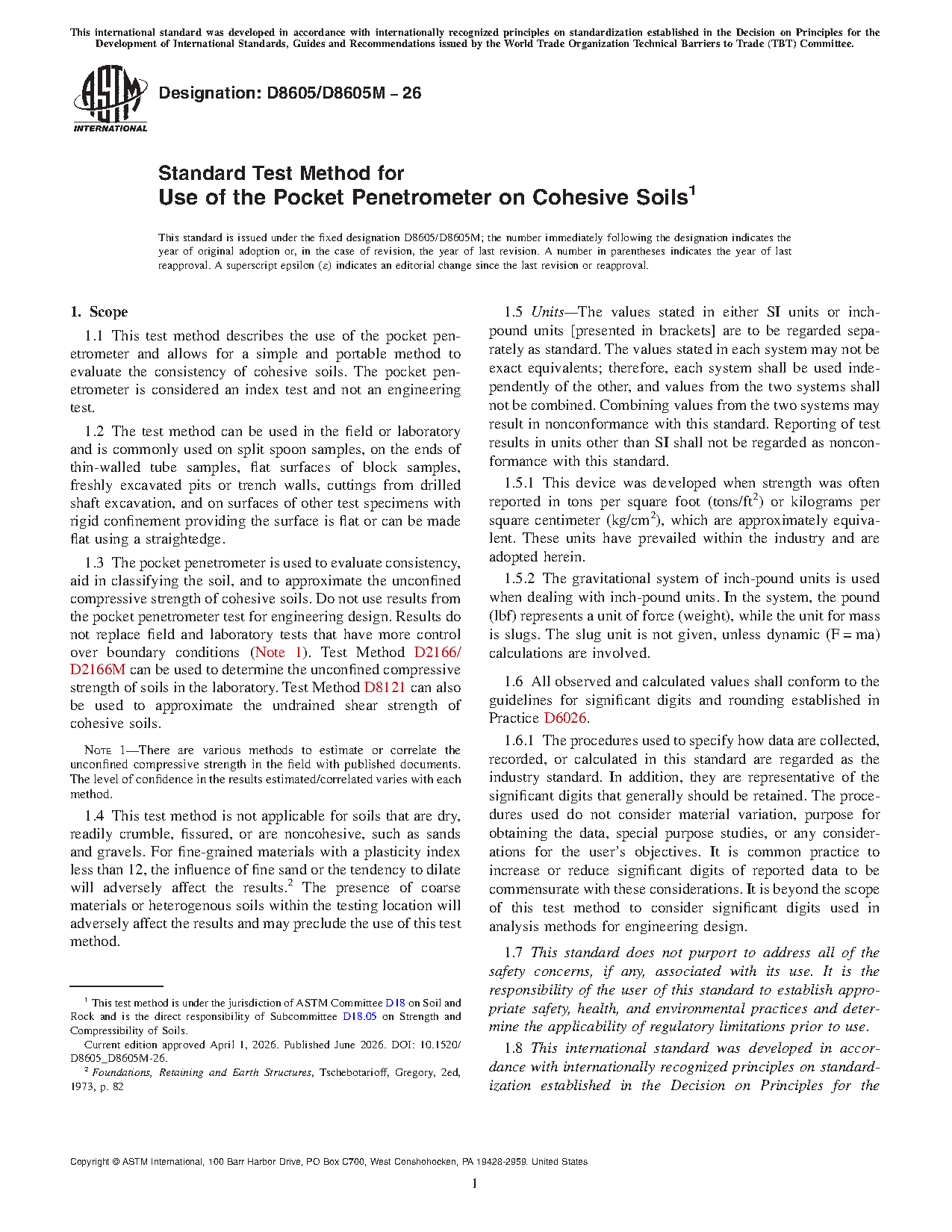
1.1 This test method describes the use of the pocket penetrometer and allows for a simple and portable method to evaluate the consistency of cohesive soils. The pocket penetrometer is considered an index test and not an engineering test.
1.2 The test method can be used in the field or laboratory and is commonly used on split spoon samples, on the ends of thin-walled tube samples, flat surfaces of block samples, freshly excavated pits or trench walls, cuttings from drilled shaft excavation, and on surfaces of other test specimens with rigid confinement providing the surface is flat or can be made flat using a straightedge.
1.3 The pocket penetrometer is used to evaluate consistency, aid in classifying the soil, and to approximate the unconfined compressive strength of cohesive soils. Do not use results from the pocket penetrometer test for engineering design. Results do not replace field and laboratory tests that have more control over boundary conditions (Note 1). Test Method D2166/D2166M can be used to determine the unconfined compressive strength of soils in the laboratory. Test Method D8121 can also be used to approximate the undrained shear strength of cohesive soils.
Note 1: There are various methods to estimate or correlate the unconfined compressive strength in the field with published documents. The level of confidence in the results estimated/correlated varies with each method.
1.4 This test method is not applicable for soils that are dry, readily crumble, fissured, or are noncohesive, such as sands and gravels. For fine-grained materials with a plasticity index less than 12, the influence of fine sand or the tendency to dilate will adversely affect the results. The presence of coarse materials or heterogenous soils within the testing location will adversely affect the results and may preclude the use of this test method.
1.5 Units—The values stated in either SI units or inch-pound units [presented in brackets] are to be regarded separately as standard. The values stated in each system may not be exact equivalents; therefore, each system shall be used independently of the other, and values from the two systems shall not be combined. Combining values from the two systems may result in nonconformance with this standard. Reporting of test results in units other than SI shall not be regarded as nonconformance with this standard.
1.5.1 This device was developed when strength was often reported in tons per square foot (tons/ft2) or kilograms per square centimeter (kg/cm2), which are approximately equivalent. These units have prevailed within the industry and are adopted herein.
1.5.2 The gravitational system of inch-pound units is used when dealing with inch-pound units. In the system, the pound (lbf) represents a unit of force (weight), while the unit for mass is slugs. The slug unit is not given, unless dynamic (F = ma) calculations are involved.
1.6 All observed and calculated values shall conform to the guidelines for significant digits and rounding established in Practice D6026.
1.6.1 The procedures used to specify how data are collected, recorded, or calculated in this standard are regarded as the industry standard. In addition, they are representative of the significant digits that generally should be retained. The procedures used do not consider material variation, purpose for obtaining the data, special purpose studies, or any considerations for the user’s objectives. It is common practice to increase or reduce significant digits of reported data to be commensurate with these considerations. It is beyond the scope of this test method to consider significant digits used in analysis methods for engineering design.
1.7 This standard does not purport to address all of the safety concerns, if any, associated with its use. It is the responsibility of the user of this standard to establish appropriate safety, health, and environmental practices and determine the applicability of regulatory limitations prior to use.
1.8 This international standard was developed in accordance with internationally recognized principles on standardization established in the Decision on Principles for the Development of International Standards, Guides and Recommendations issued by the World Trade Organization Technical Barriers to Trade (TBT) Committee.
Significance and Use:
5.1 The pocket penetrometer was developed in the 1960’s and 1970’s as an empirical device relating penetration to unconfined compressive strength. Literature of that era shows thousands of correlations of silty clays and clays with laboratory unconfined compressive strength data versus pocket penetrometer readings. Further, independent studies of its effectiveness have been documented in published literature.
5.2 In this test method, the pocket penetrometer readings provide a rapid method of estimating the consistency of a material, which may then be used to approximate unconfined compressive strength and aid in the selection of transducers for strength testing. The pocket penetrometer test is not used to duplicate any particular field conditions, but supplements the overall exploration program. However, consistent physical parameters are used in the test such that correlations of unconfined compressive strength data can be made to evaluate variability of a deposit, assess sample quality, assist in planning of laboratory testing programs, and to classify the consistency of the soil. It should be used only as an approximation or in conjunction with other tests. This test does not replace laboratory testing for comprehensive field evaluations and must not be used to produce engineering design data.
5.3 Pocket penetrometer values most favorably compare with unconfined compression test data for saturated, silty clays to clays without appreciable particles greater than 2.0 mm [0.079 in.] in size. Surfaces that have air dried or particles larger than 2.0 mm [0.079 in.] in size within 1 diameter of the pocket penetrometer’s shaft may adversely affect the results. Testing should be performed on surfaces as soon as exposed to air to reduce the impact of drying due to air exposure.
Note 2: The quality of the result produced by this standard is dependent on the competence of the personnel performing it, and the suitability of the equipment and facilities used. Agencies that meet the criteria of Practice D3740 are generally considered capable of competent and objective testing/sampling/inspection. Reliable results depend on many factors; Practice D3740 provides a means of evaluating some, but not all, of those factors.
Technical characteristics
| Publisher | American Society for Testing and Materials (ASTM International) |
| Publication Date | 04/01/2026 |
| Collection | |
| Page Count | 6 |
| EAN | --- |
| ISBN | --- |
| Weight (in grams) | --- |
Previous versions
Collections list