ASTM D5367-26
 Preview
Summary
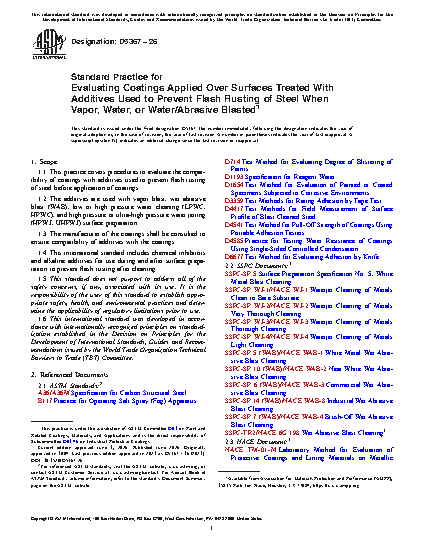
1.1 This practice covers procedures to evaluate the compatibility of coatings with additives used to prevent flash rusting of steel before application of coatings.
1.2 The additives are used with vapor blast, wet abrasive blast (WAB), low or high pressure water cleaning (LPWC, HPWC), and high pressure or ultra-high pressure water jetting (HPWJ, UHPWJ) surface preparation.
1.3 The manufacturer of the coatings shall be consulted to ensure compatibility of additives with the coatings.
1.4 This international standard includes chemical inhibitors and alkaline additives for use during and after surface preparation to prevent flash rusting after cleaning.
1.5 This standard does not purport to address all of the safety concerns, if any, associated with its use. It is the responsibility of the user of this standard to establish appropriate safety, health, and environmental practices and determine the applicability of regulatory limitations prior to use.
1.6 This international standard was developed in accordance with internationally recognized principles on standardization established in the Decision on Principles for the Development of International Standards, Guides and Recommendations issued by the World Trade Organization Technical Barriers to Trade (TBT) Committee.
Significance and Use:
3.1 Water-blast cleaning with (SSPC-TR2/NACE 6G 198; SSPC-SP 5 (WAB)/NACE WAB-1; SSPC-SP 10 (WAB)/NACE WAB-2; SSPC-SP 6 (WAB)/NACE WAB-3; SSPC-SP 14 (WAB)/NACE WAB-8); SSPC-SP 7 (WAB)/NACE WAB-4 or without, (SSPC-SP WJ-1/NACE WJ-1; SSPC-SP WJ-2/NACE WJ-2; SSPC-SP WJ-3/NACE WJ-3; SSPC-SP WJ-4/NACE WJ-4) abrasive, results in flash rusting under some environmental conditions. Inhibitors or alkaline additives are used to prevent flash rusting while drying and before coating application. The inhibitor/additive or reaction products of the inhibitor/additive on the substrate can become part of the coating systems, depending on formulation of the inhibitor or additive. Coating performance may be influenced by the inhibitor or additive. Soluble contaminants or highly concentrated or unreacted additives left on the surface under the coating may cause premature failure. This practice includes a comparison of coating performance with and without additives using various laboratory tests to simulate a range of conditions such as high moisture, marine atmospheric, or water immersion.
3.2 The user or specifier must determine the specific test methods to be used and exposure conditions. Some test methods referenced may not be applicable to all types of coatings.
3.3 Corrosion Inhibitors
work through various pathways and can be anodic inhibitors, cathodic inhibitors, or mixed/absorption type inhibitors reducing the overall corrosion rate by interfering with the electrochemical reaction in the corrosion cell.
3.4 Alkaline Additives
work through exposing the steel substrate to a high-pH environment causing a natural passivation barrier to form on the surface dramatically reducing the anodic reaction rate through iron dissolution significantly dropping the current density.
3.5 Though there are many distinct differences between the various products and reactions, this document will simply refer to these as “Product” throughout the remainder of the document.
Technical characteristics
| Publisher | American Society for Testing and Materials (ASTM International) |
| Publication Date | 06/01/2026 |
| Collection | |
| Page Count | 3 |
| Themes | Paints and varnishes |
| EAN | --- |
| ISBN | --- |
| Weight (in grams) | --- |
Replaces

Previous versions


Collections list