
ASTM C901-26
 Preview
Summary
1.1 This guide provides information regarding masonry elements constructed at locations other than in-place. Prefabrication may occur on the jobsite or offsite and transported to the jobsite. This guide covers lintels, arches, sloped sills, spandrels, soffits, wall panels, and other masonry elements constructed with masonry units assembled using some combination of mortar, adhesives, reinforcing (conventional or post-tensioned), grout, lifting hardware, and anchors. This guide does not cover thin adhered masonry assemblies or masonry units embedded in a concrete panel. This guide does not currently address prefabricated, unitized wall assemblies that include the backings such as masonry veneer on cold-formed steel framed walls.
1.2 Units—The values stated in inch-pound units are to be regarded as standard. The values given in parentheses are mathematical conversions to SI units that are provided for information only and are not considered standard.
1.3 The text of this standard references notes and footnotes that provide explanatory material. These notes and footnotes (excluding those in tables and figures) shall not be considered as requirements of the standard.
1.4 This standard does not purport to address all of the safety concerns, if any, associated with its use. It is the responsibility of the user of this standard to establish appropriate safety, health, and environmental practices and determine the applicability of regulatory limitations prior to use.
1.5 This international standard was developed in accordance with internationally recognized principles on standardization established in the Decision on Principles for the Development of International Standards, Guides and Recommendations issued by the World Trade Organization Technical Barriers to Trade (TBT) Committee.
Rationale:
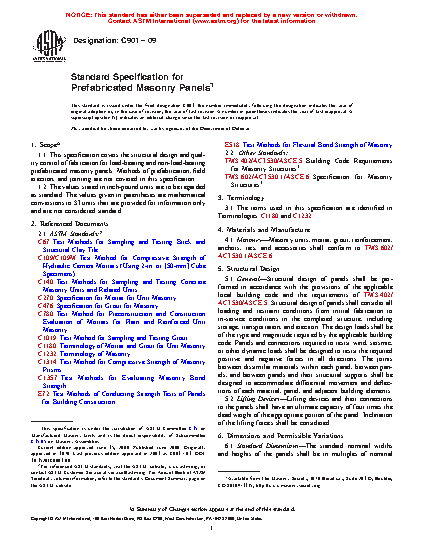
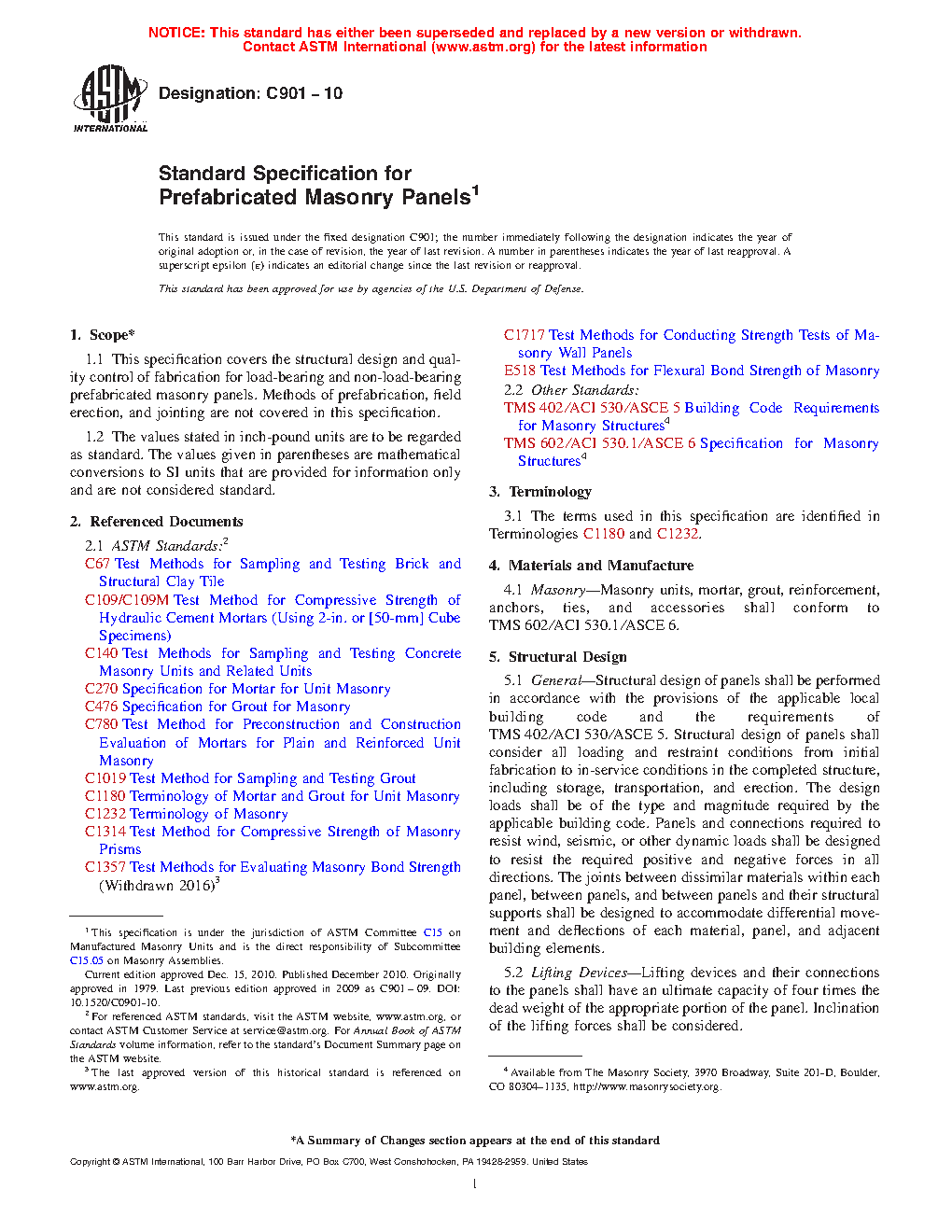
This specification covers the structural design and quality control of fabrication for load-bearing and non-load-bearing prefabricated masonry panels. Structural design of panels shall be performed in accordance with the provisions of the applicable local building code and the requirements specified. A quality control test shall be made in accordance with the specified requirements.
Significance and Use:
4.1 This guide is intended to provide information and guidance for designers, specifiers, manufacturers, contractors and users that are considering the use of prefabricated masonry elements. This guide identifies situations when prefabrication could be considered where other prefabricated systems are used, as a viable alternative to in-place masonry construction, or to achieve masonry designs that are not possible or practical with conventional masonry. The guide also identifies issues and special considerations associated with common prefabricated uses of masonry.
4.2 Situations where prefabrication may be considered:
4.2.1 To mitigate material and workmanship issues for masonry installed during extreme weather conditions or when other difficult exterior environmental conditions exist.
4.2.2 To allow masonry to be constructed in controlled working conditions permitting increased productivity, faster completion, or improved quality control.
4.2.3 To reduce construction schedules by beginning construction of certain elements before masonry is typically ready to be installed.
4.2.4 To reduce storage on site when staging areas are limited.
4.2.5 To facilitate masonry construction in areas where site access is difficult (such as masonry elements installed with a crane).
4.2.6 To allow the use of jigs or templates that can be reused multiple times to create recurring or repetitive masonry elements.
4.2.7 To avoid the need for centering and temporary shoring or formwork for lintels and arches.
4.2.8 To create special architectural designs that are easier to fabricate in an orientation different than the final position on the building.
4.2.9 To allow masonry elements to contain fewer masonry connection points thereby reducing thermal bridging.
4.2.10 Where reduction in waste, noise, or dust on a jobsite is important.
4.2.11 When safety precautions for onsite masonry construction are difficult to incorporate on a jobsite.
Technical characteristics
| Publisher | American Society for Testing and Materials (ASTM International) |
| Publication Date | 06/01/2026 |
| Collection | |
| Page Count | 5 |
| Themes | Facades |
| EAN | --- |
| ISBN | --- |
| Weight (in grams) | --- |
Replaces
Previous versions
Collections list