ASTM C666/C666M-26
 Preview
Summary
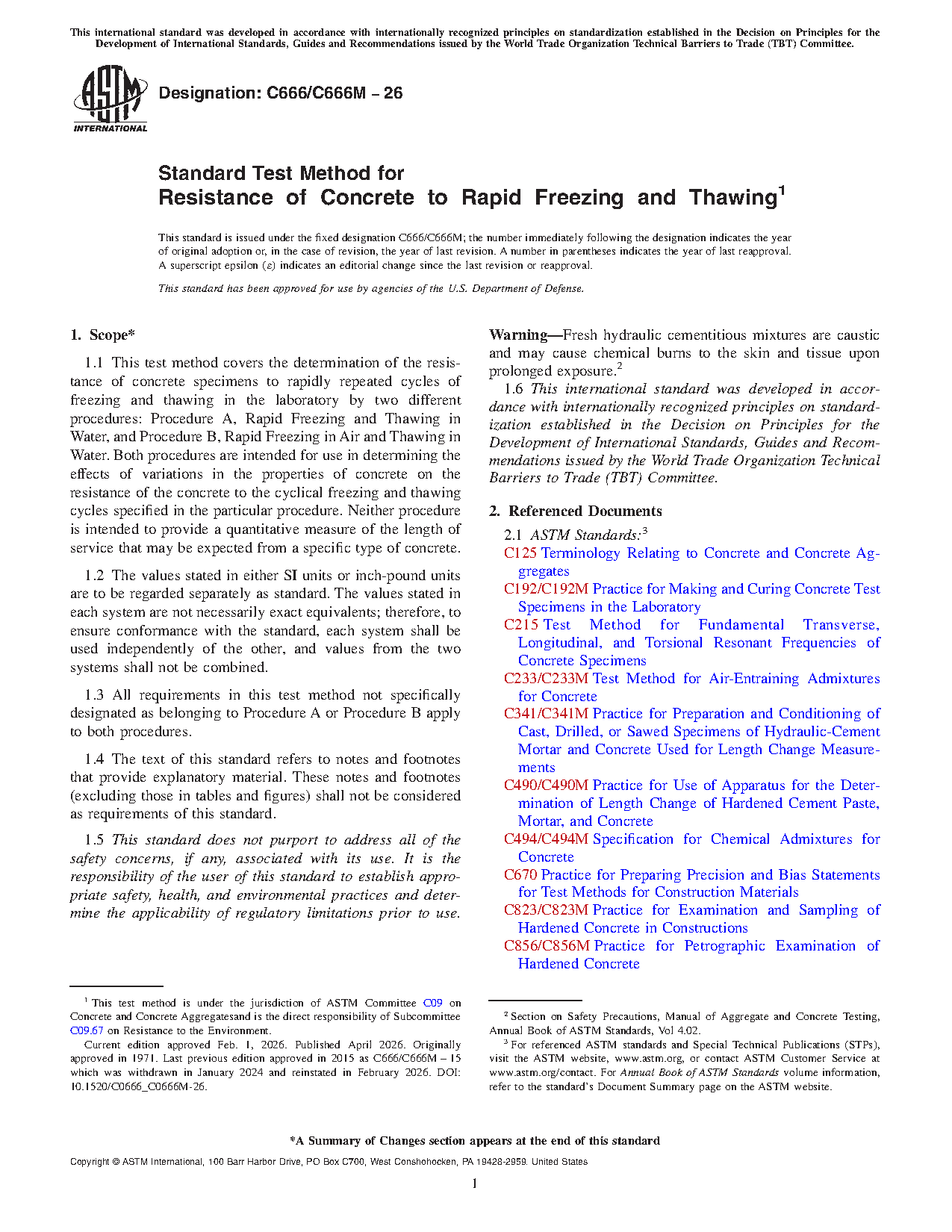
1.1 This test method covers the determination of the resistance of concrete specimens to rapidly repeated cycles of freezing and thawing in the laboratory by two different procedures: Procedure A, Rapid Freezing and Thawing in Water, and Procedure B, Rapid Freezing in Air and Thawing in Water. Both procedures are intended for use in determining the effects of variations in the properties of concrete on the resistance of the concrete to the cyclical freezing and thawing cycles specified in the particular procedure. Neither procedure is intended to provide a quantitative measure of the length of service that may be expected from a specific type of concrete.
1.2 The values stated in either SI units or inch-pound units are to be regarded separately as standard. The values stated in each system are not necessarily exact equivalents; therefore, to ensure conformance with the standard, each system shall be used independently of the other, and values from the two systems shall not be combined.
1.3 All requirements in this test method not specifically designated as belonging to Procedure A or Procedure B apply to both procedures.
1.4 The text of this standard refers to notes and footnotes that provide explanatory material. These notes and footnotes (excluding those in tables and figures) shall not be considered as requirements of this standard.
1.5 This standard does not purport to address all of the safety concerns, if any, associated with its use. It is the responsibility of the user of this standard to establish appropriate safety, health, and environmental practices and determine the applicability of regulatory limitations prior to use. Warning—Fresh hydraulic cementitious mixtures are caustic and may cause chemical burns to the skin and tissue upon prolonged exposure.
1.6 This international standard was developed in accordance with internationally recognized principles on standardization established in the Decision on Principles for the Development of International Standards, Guides and Recommendations issued by the World Trade Organization Technical Barriers to Trade (TBT) Committee.
Significance and Use:
4.1 This test method provides two separate procedures, each providing different exposure conditions, to determine the resistance of concrete to cyclical freezing and thawing. This test method is used in Specification C494/C494M and Test Method C233/C233M, and it is also used to evaluate the effect of a coarse aggregate on a concrete mixture’s resistance to cyclic freezing and thawing.
4.2 These procedures are assumed to have no significant damaging effect on concrete that is resistant to cyclical freezing and thawing. Concrete resistant to cyclical freezing and thawing is defined as concrete that has one or more of the following properties (1) not sufficiently saturated with water to be damaged by freezing, (2) made with aggregates resistant to cyclical freezing and thawing, (3) adequately air entrained, and (4) cured to achieve the appropriate maturity necessary to resist the actions of cyclical freezing and thawing.
4.3 No relationship has been established between the resistance to cyclical of freezing and thawing of specimens cut from hardened concrete and specimens prepared in the laboratory.
4.4 There is no specific guidance on choosing between Procedure A and Procedure B for a given application, except when contained in a specification. Test Method C233/C233M and Specification C494/C494M both stipulate Procedure A. In many instances the choice is based on the user’s determination of suitability to a specific application. Procedure A is generally considered to be the more aggressive of the two and to better reveal defective materials, although some consider the constant saturation of the test specimens to be unrealistic. Some users prefer Procedure B as being more representative of the saturation patterns in some field applications. The history of this standard and a more complete discussion of significance and use can be found in ASTM STP 169D.
Technical characteristics
| Publisher | American Society for Testing and Materials (ASTM International) |
| Publication Date | 02/01/2026 |
| Collection | |
| Page Count | 7 |
| Themes | Concrete and concrete products |
| EAN | --- |
| ISBN | --- |
| Weight (in grams) | --- |
Replaces

Previous versions

Collections list