
Nuclear energy :

Overview of the Nuclear Industry up to date


The nuclear industry is undergoing a phase of renewal, though cautious, after a period of stagnation in the 2010s. It remains a strategic pillar for many countries, at the crossroads of energy, climate, economic and geopolitical issues.


Role in the Energy Transition


Nowadays, nuclear power is recognized as a low-carbon, dispatchable source of electricity capable of continuous production. In the context of slowing climate change while reducing dependence on fossil fuels, several countries consider nuclear energy as an essential complement to renewable energies (wind, solar), which are intermittent.
  

A Contrasting Global Landscape


  • Pro-nuclear countries: France, China, Russia, South Korea, and more recently, the United Kingdom and some Eastern European countries are currently investing in new reactors.
  • Retreat from or phase-out of nuclear power: Germany has closed its power plants, while other countries remain hesitant for political, economic, or societal reasons.
  • New entrants: Countries like the United Arab Emirates and Turkey are developing their first nuclear capacity.


Industrial and Economical Challenges


The area is currently facing some obstacles. 

  • ​High costs and budget overruns on major reactor projects.
  • Long construction times, which tend to hinder investment
  • The existing fleet are aging, particularly in Europe and North America, requiring extension or replacement programs.
  • Radioactive waste management, remaining a sensitive political and societal issue.


Innovations and New Technologies


One of the area's greatest hope lies in SMRs (Small Modular Reactors): smaller, standardized reactors that are potentially cheaper and more flexible. Moreover, research is also progressing on:

  •  safer, next-generation reactors,
  • fuel recycling,
  • and, in the longer run, nuclear fusion, which remains experimental.


Geopolitical and Sovereignty Issues


Nuclear energy is closely intertwined with energy sovereignty. Mastering the technology, uranium and the fuel cycle has become strategic, especially in a context of international tensions, added to a search for independence from energy imports.
  

Major Publications Regarding Nuclear Energy

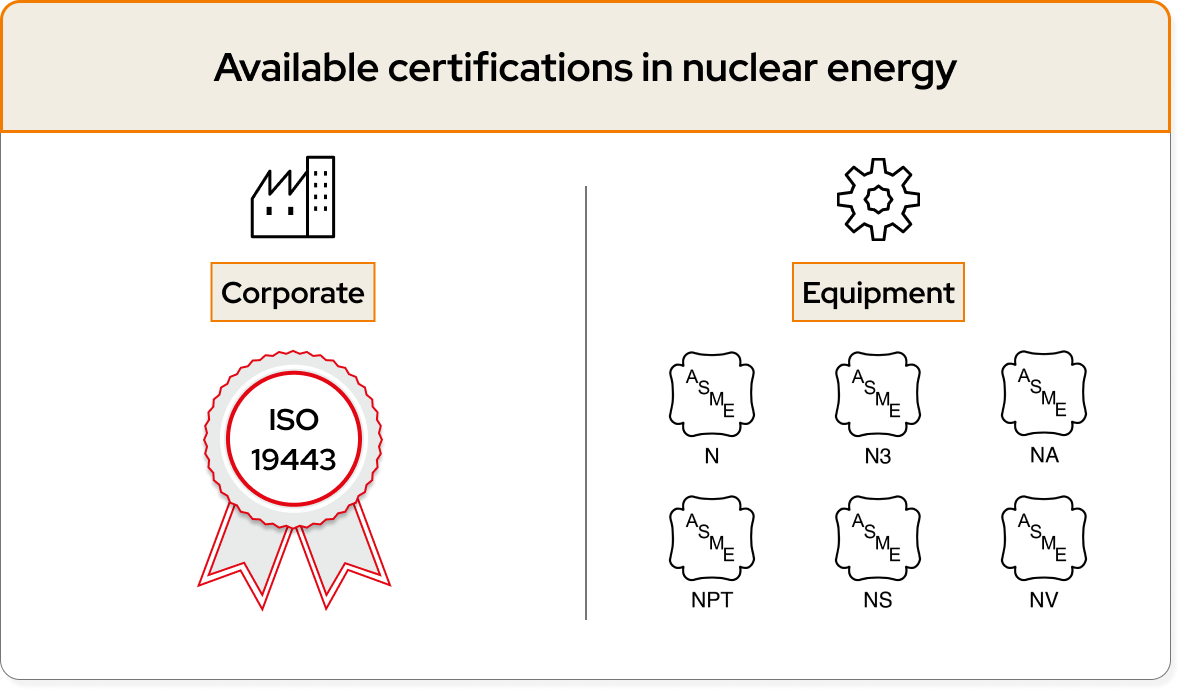
There are many standards focusing on nuclear energy. The most prominent ones are RCC-M, the ASME Code, and ISO 19443.

You can read our detailed brochure in order to know more about the collection of standards related to nuclear energy.

The Certifications


All the documentation related to nuclear energy

ISO 16797:2004 (R2022)

ISO 16797:2004 (R2022)

Active Most Recent

Nuclear energy — Soxhlet-mode chemical durability test — Application to vitrified matrixes for high-level radioactive waste

€77.00

View more
ISO 21847-1:2007 (R2021)

ISO 21847-1:2007 (R2021)

Active Most Recent

Nuclear fuel technology — Alpha spectrometry Part 1: Determination of neptunium in uranium and its compounds

€51.00

View more
ISO 21847-2:2007 (R2021)

ISO 21847-2:2007 (R2021)

Active Most Recent

Nuclear fuel technology — Alpha spectrometry Part 2: Determination of plutonium in uranium and its compounds

€51.00

View more
ISO 21847-3:2007 (R2021)

ISO 21847-3:2007 (R2021)

Active Most Recent

Nuclear fuel technology — Alpha spectrometry Part 3: Determination of uranium 232 in uranium and its compounds

€51.00

View more
ISO 9278:2008 (R2022)

ISO 9278:2008 (R2022)

Active Most Recent

Nuclear energy - Uranium dioxide pellets — Determination of density and volume fraction of open and closed porosity

€77.00

View more
ISO 18213-1:2007 (R2021)

ISO 18213-1:2007 (R2021)

Active Most Recent

Nuclear fuel technology — Tank calibration and volume determination for nuclear materials accountancy Part 1: Procedural overview

€155.00

View more
ISO 18213-2:2007 (R2021)

ISO 18213-2:2007 (R2021)

Active Most Recent

Nuclear fuel technology — Tank calibration and volume determination for nuclear materials accountancy Part 2: Data standardization for tank calibration

€115.00

View more
ISO 18213-4:2008 (R2021)

ISO 18213-4:2008 (R2021)

Active Most Recent

Nuclear fuel technology — Tank calibration and volume determination for nuclear materials accountancy Part 4: Accurate determination of liquid height in accountancy tanks equipped with dip tubes, slow bubbling rate

€155.00

View more
ISO 18213-5:2008 (R2021)

ISO 18213-5:2008 (R2021)

Active Most Recent

Nuclear fuel technology — Tank calibration and volume determination for nuclear materials accountancy Part 5: Accurate determination of liquid height in accountancy tanks equipped with dip tubes, fast bubbling rate

€115.00

View more
ISO 18213-6:2008 (R2021)

ISO 18213-6:2008 (R2021)

Active Most Recent

Nuclear fuel technology — Tank calibration and volume determination for nuclear materials accountancy Part 6: Accurate in-tank determination of liquid density in accountancy tanks equipped with dip tubes

€77.00

View more
ISO 18213-3:2009 (R2025)

ISO 18213-3:2009 (R2025)

Active Most Recent

Nuclear fuel technology — Tank calibration and volume determination for nuclear materials accountancy Part 3: Statistical methods

€208.00

View more
ISO 26062:2010 (R2022)

ISO 26062:2010 (R2022)

Active Most Recent

Nuclear technology — Nuclear fuels — Procedures for the measurement of elemental impurities in uranium- and plutonium-based materials by inductively coupled plasma mass spectrometry

€155.00

View more
ISO 26802:2010 (R2021)

ISO 26802:2010 (R2021)

Active Most Recent

Nuclear facilities — Criteria for the design and the operation of containment and ventilation systems for nuclear reactors

€261.00

View more
ISO 27467:2009 (R2020)

ISO 27467:2009 (R2020)

Active Most Recent

Nuclear criticality safety — Analysis of a postulated criticality accident

€77.00

View more
ISO 27468:2011 (R2023)

ISO 27468:2011 (R2023)

Active Most Recent

Nuclear criticality safety — Evaluation of systems containing PWR UOX fuels — Bounding burnup credit approach

€77.00

View more