
Nuclear energy :

Overview of the Nuclear Industry up to date


The nuclear industry is undergoing a phase of renewal, though cautious, after a period of stagnation in the 2010s. It remains a strategic pillar for many countries, at the crossroads of energy, climate, economic and geopolitical issues.


Role in the Energy Transition


Nowadays, nuclear power is recognized as a low-carbon, dispatchable source of electricity capable of continuous production. In the context of slowing climate change while reducing dependence on fossil fuels, several countries consider nuclear energy as an essential complement to renewable energies (wind, solar), which are intermittent.
  

A Contrasting Global Landscape


  • Pro-nuclear countries: France, China, Russia, South Korea, and more recently, the United Kingdom and some Eastern European countries are currently investing in new reactors.
  • Retreat from or phase-out of nuclear power: Germany has closed its power plants, while other countries remain hesitant for political, economic, or societal reasons.
  • New entrants: Countries like the United Arab Emirates and Turkey are developing their first nuclear capacity.


Industrial and Economical Challenges


The area is currently facing some obstacles. 

  • ​High costs and budget overruns on major reactor projects.
  • Long construction times, which tend to hinder investment
  • The existing fleet are aging, particularly in Europe and North America, requiring extension or replacement programs.
  • Radioactive waste management, remaining a sensitive political and societal issue.


Innovations and New Technologies


One of the area's greatest hope lies in SMRs (Small Modular Reactors): smaller, standardized reactors that are potentially cheaper and more flexible. Moreover, research is also progressing on:

  •  safer, next-generation reactors,
  • fuel recycling,
  • and, in the longer run, nuclear fusion, which remains experimental.


Geopolitical and Sovereignty Issues


Nuclear energy is closely intertwined with energy sovereignty. Mastering the technology, uranium and the fuel cycle has become strategic, especially in a context of international tensions, added to a search for independence from energy imports.
  

Major Publications Regarding Nuclear Energy

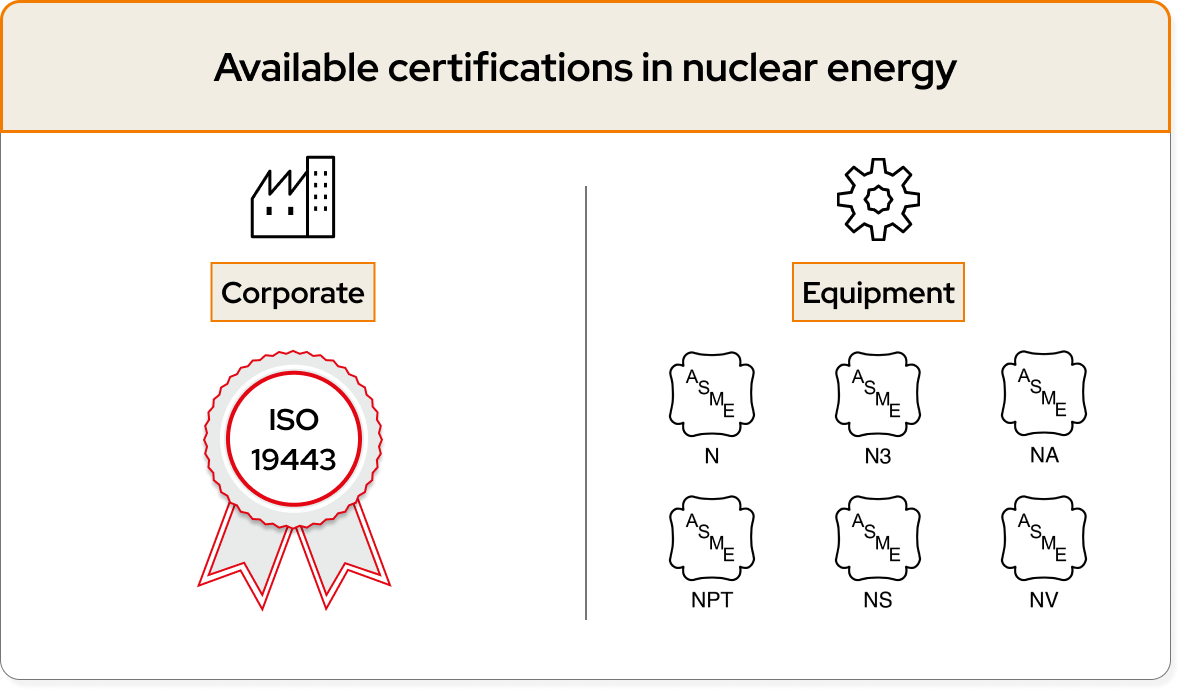
There are many standards focusing on nuclear energy. The most prominent ones are RCC-M, the ASME Code, and ISO 19443.

You can read our detailed brochure in order to know more about the collection of standards related to nuclear energy.

The Certifications


All the documentation related to nuclear energy

ISO 18075:2018

ISO 18075:2018

Active Most Recent

Steady-state neutronics methods for power-reactor analysis

€155.00

View more
ISO 18195:2019

ISO 18195:2019

Active Most Recent

Method for the justification of fire partitioning in water cooled nuclear power plants (NPP)

€235.00

View more
ISO 18229:2018 (R2023)

ISO 18229:2018 (R2023)

Active Most Recent

Essential technical requirements for mechanical components and metallic structures foreseen for Generation IV nuclear reactors

€183.00

View more
ISO 18557:2017 (R2023)

ISO 18557:2017 (R2023)

Active Most Recent

Characterisation principles for soils, buildings and infrastructures contaminated by radionuclides for remediation purposes

€208.00

View more
ISO 12807:2018 (R2023)

ISO 12807:2018 (R2023)

Active Most Recent

Safe transport of radioactive materials — Leakage testing on packages

This product is not for sale, please contact us for more information

View more
ISO 11311:2011 (R2024)

ISO 11311:2011 (R2024)

Active Most Recent

Nuclear criticality safety — Critical values for homogeneous plutonium-uranium oxide fuel mixtures outside of reactors

€115.00

View more
ISO 11320:2011 (R2023)

ISO 11320:2011 (R2023)

Active Most Recent

Nuclear criticality safety — Emergency preparedness and response

€77.00

View more
ISO 16966:2013 (R2025)

ISO 16966:2013 (R2025)

Active Most Recent

Nuclear energy — Nuclear fuel technology — Theoretical activation calculation method to evaluate the radioactivity of activated waste generated at nuclear reactors

€208.00

View more
ISO 21613:2015 (R2022)

ISO 21613:2015 (R2022)

Active Most Recent

(U, Pu)O2 Powders and sintered pellets — Determination of chlorine and fluorine

€77.00

View more
ISO 15646:2014 (R2024)

ISO 15646:2014 (R2024)

Active Most Recent

Re-sintering test for UO2, (U,Gd)O2 and (U,Pu)O2 pellets

€51.00

View more
ISO 21483:2013 (R2022)

ISO 21483:2013 (R2022)

Active Most Recent

Determination of solubility in nitric acid of plutonium in unirradiated mixed oxide fuel pellets (U, Pu) O2

€51.00

View more
ISO 16793:2018 (R2023)

ISO 16793:2018 (R2023)

Active Most Recent

Nuclear fuel technology — Guidelines for ceramographic preparation of UO2 sintered pellets for microstructure examination

€77.00

View more
ISO 15647:2004 (R2025)

ISO 15647:2004 (R2025)

Active Most Recent

Nuclear energy — Isotopic analysis of uranium hexafluoride — Double-standard gas-source mass spectrometric method

€51.00

View more
ISO 8298:2000 (R2025)

ISO 8298:2000 (R2025)

Active Most Recent

Nuclear fuel technology — Determination of milligram amounts of plutonium in nitric acid solutions — Potentiometric titration with potassium dichromate after oxidation by Ce(IV) and reduction by Fe(II)

€77.00

View more
ISO 16794:2003 (R2025)

ISO 16794:2003 (R2025)

Active Most Recent

Nuclear energy — Determination of carbon compounds and fluorides in uranium hexafluoride infrared spectrometry

€51.00

View more