
Nuclear energy :

Overview of the Nuclear Industry up to date


The nuclear industry is undergoing a phase of renewal, though cautious, after a period of stagnation in the 2010s. It remains a strategic pillar for many countries, at the crossroads of energy, climate, economic and geopolitical issues.


Role in the Energy Transition


Nowadays, nuclear power is recognized as a low-carbon, dispatchable source of electricity capable of continuous production. In the context of slowing climate change while reducing dependence on fossil fuels, several countries consider nuclear energy as an essential complement to renewable energies (wind, solar), which are intermittent.
  

A Contrasting Global Landscape


  • Pro-nuclear countries: France, China, Russia, South Korea, and more recently, the United Kingdom and some Eastern European countries are currently investing in new reactors.
  • Retreat from or phase-out of nuclear power: Germany has closed its power plants, while other countries remain hesitant for political, economic, or societal reasons.
  • New entrants: Countries like the United Arab Emirates and Turkey are developing their first nuclear capacity.


Industrial and Economical Challenges


The area is currently facing some obstacles. 

  • ​High costs and budget overruns on major reactor projects.
  • Long construction times, which tend to hinder investment
  • The existing fleet are aging, particularly in Europe and North America, requiring extension or replacement programs.
  • Radioactive waste management, remaining a sensitive political and societal issue.


Innovations and New Technologies


One of the area's greatest hope lies in SMRs (Small Modular Reactors): smaller, standardized reactors that are potentially cheaper and more flexible. Moreover, research is also progressing on:

  •  safer, next-generation reactors,
  • fuel recycling,
  • and, in the longer run, nuclear fusion, which remains experimental.


Geopolitical and Sovereignty Issues


Nuclear energy is closely intertwined with energy sovereignty. Mastering the technology, uranium and the fuel cycle has become strategic, especially in a context of international tensions, added to a search for independence from energy imports.
  

Major Publications Regarding Nuclear Energy

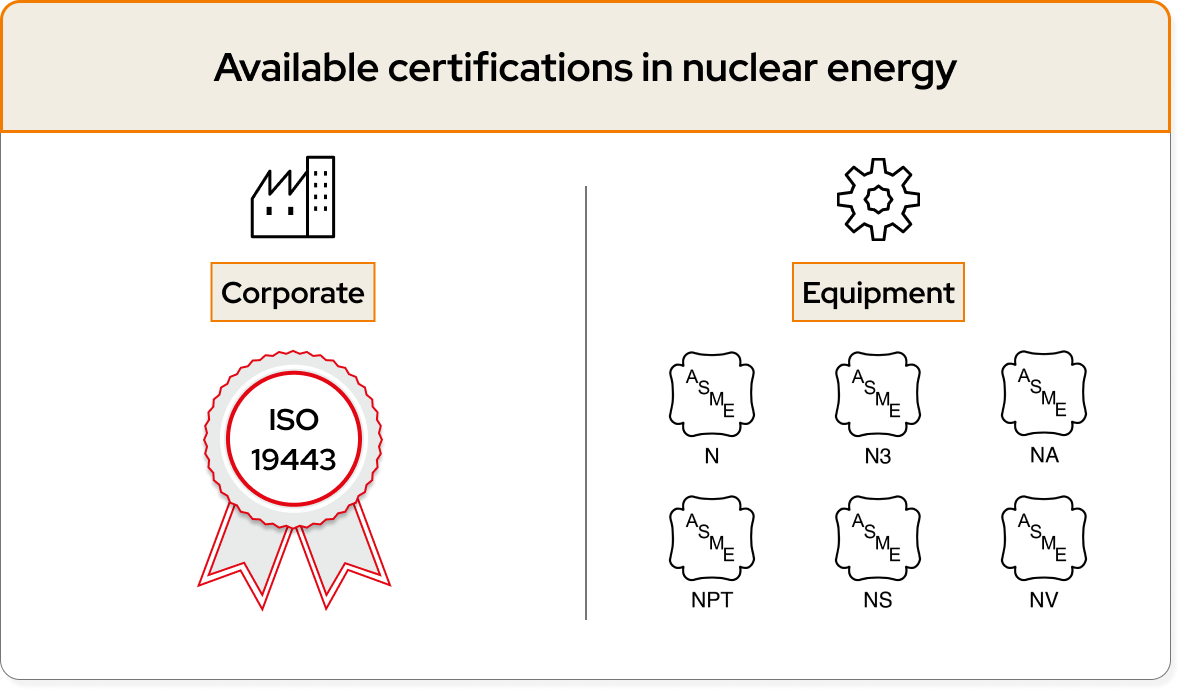
There are many standards focusing on nuclear energy. The most prominent ones are RCC-M, the ASME Code, and ISO 19443.

You can read our detailed brochure in order to know more about the collection of standards related to nuclear energy.

The Certifications


All the documentation related to nuclear energy

BS ISO 15080:2001+A1:2019

BS ISO 15080:2001+A1:2019

Active Most Recent

Nuclear facilities. Ventilation penetrationsfor shielded enclosures

€269.00

View more
BS ISO 23467:2020

BS ISO 23467:2020

Active Most Recent

Ice plug isolation of piping in nuclear power plant

€269.00

View more
BS ISO 23468:2021

BS ISO 23468:2021

Active Most Recent

Reactor technology. Power reactor analyses and measurements. Determination of heavy water isotopic purity by Fourier transform infrared spectroscopy

€269.00

View more
BS ISO 10645:2022

BS ISO 10645:2022

Active Most Recent

Nuclear energy. Light water reactors. Decay heat power in non-recycled nuclear fuels

€269.00

View more
BS EN ISO 12799:2019

BS EN ISO 12799:2019

Active Most Recent

Nuclear energy. Determination of nitrogen content in UO2, (U,Gd)O2 and (U,Pu)O2 sintered pellets. Inert gas extraction and conductivity detection method

€165.00

View more
BS ISO 16659-1:2022

BS ISO 16659-1:2022

Active Most Recent

Ventilation systems for nuclear facilities. In-situ efficiency test methods iodine traps with solid sorbent General requirements

€269.00

View more
BS ISO 18077:2022

BS ISO 18077:2022

Active Most Recent

Reload startup physics tests for pressurized water reactors

€316.00

View more
NBN ISO 8939:2026

NBN ISO 8939:2026

Active Most Recent

Decommissioning of medical cyclotron

€92.00

View more
DIN EN ISO 21243:2026-03

DIN EN ISO 21243:2026-03

Active Most Recent

Radiation protection - Performance criteria for laboratories performing initial cytogenetic dose assessment of mass casualties in radiological or nuclear emergencies - General principles and application to dicentric assay (ISO 21243:2022); German version EN ISO 21243:2025

€91.03

View more
DIN 25420-1 Beiblatt 2:2026-03

DIN 25420-1 Beiblatt 2:2026-03

Active Most Recent

Construction of concrete hot cells - Part 1: Requirements for remotely operated cells; Supplement 2: Shielding calculation

€63.27

View more
NBN ISO 22875:2020

NBN ISO 22875:2020

Active Most Recent

Nuclear energy — Determination of chlorine and fluorine in uranium dioxide powder and sintered pellets

€58.00

View more
NBN ISO 21391:2020

NBN ISO 21391:2020

Active Most Recent

Nuclear criticality safety — Geometrical dimensions for subcriticality control — Equipment and layout

€89.00

View more
NBN ISO 22946:2020

NBN ISO 22946:2020

Active Most Recent

Nuclear criticality safety — Solid waste excluding irradiated and non-irradiated nuclear fuel

€58.00

View more
NBN ISO 18195:2020

NBN ISO 18195:2020

Active Most Recent

Method for the justification of fire partitioning in water cooled nuclear power plants (NPP)

€184.00

View more
NBN ISO 23133:2021

NBN ISO 23133:2021

Active Most Recent

Nuclear criticality safety — Nuclear criticality safety training for operations

€58.00

View more