
Nuclear energy :

Overview of the Nuclear Industry up to date


The nuclear industry is undergoing a phase of renewal, though cautious, after a period of stagnation in the 2010s. It remains a strategic pillar for many countries, at the crossroads of energy, climate, economic and geopolitical issues.


Role in the Energy Transition


Nowadays, nuclear power is recognized as a low-carbon, dispatchable source of electricity capable of continuous production. In the context of slowing climate change while reducing dependence on fossil fuels, several countries consider nuclear energy as an essential complement to renewable energies (wind, solar), which are intermittent.

  

A Contrasting Global Landscape


  • Pro-nuclear countries: France, China, Russia, South Korea, and more recently, the United Kingdom and some Eastern European countries are currently investing in new reactors.
  • Retreat from or phase-out of nuclear power: Germany has closed its power plants, while other countries remain hesitant for political, economic, or societal reasons.
  • New entrants: Countries like the United Arab Emirates and Turkey are developing their first nuclear capacity.


Industrial and Economical Challenges


The area is currently facing some obstacles. 

  • ​High costs and budget overruns on major reactor projects.
  • Long construction times, which tend to hinder investment
  • The existing fleet are aging, particularly in Europe and North America, requiring extension or replacement programs.
  • Radioactive waste management, remaining a sensitive political and societal issue.


Innovations and New Technologies


One of the area's greatest hope lies in SMRs (Small Modular Reactors): smaller, standardized reactors that are potentially cheaper and more flexible. Moreover, research is also progressing on:

  •  safer, next-generation reactors,
  • fuel recycling,
  • and, in the longer run, nuclear fusion, which remains experimental.


Geopolitical and Sovereignty Issues


Nuclear energy is closely intertwined with energy sovereignty. Mastering the technology, uranium and the fuel cycle has become strategic, especially in a context of international tensions, added to a search for independence from energy imports.
  

Major Publications Regarding Nuclear Energy

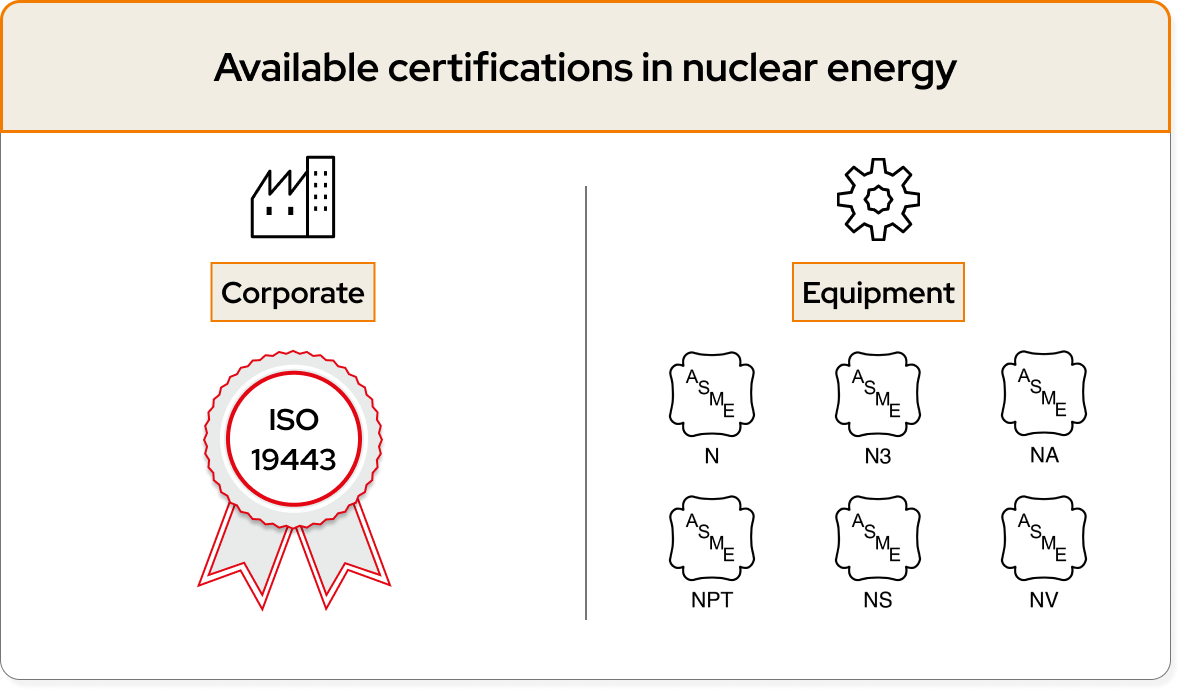
There are many standards focusing on nuclear energy. The most prominent ones are RCC-M, the ASME Code, and ISO 19443.

You can read our detailed brochure in order to know more about the collection of standards related to nuclear energy.

The Certifications


All the documentation related to nuclear energy

BS EN ISO 16793:2021

BS EN ISO 16793:2021

Active Most Recent

Nuclear fuel technology. Guidelines for ceramographic preparation of UO2 sintered pellets for microstructure examination

€193.00

View more
BS EN ISO 12807:2021

BS EN ISO 12807:2021

Active Most Recent

Safe transport of radioactive materials. Leakage testing on packages

€404.00

View more
BS EN ISO 18256-1:2021

BS EN ISO 18256-1:2021

Active Most Recent

Nuclear fuel technology. Dissolution of plutonium dioxide-containing materials dioxide powders

€193.00

View more
BS EN ISO 8299:2021

BS EN ISO 8299:2021

Active Most Recent

Nuclear fuel technology. Determination of the isotopic and elemental uranium and plutonium concentrations of nuclear materials in nitric acid solutions by thermal-ionization mass spectrometry

€316.00

View more
BS EN ISO 23133:2022

BS EN ISO 23133:2022

Active Most Recent

Nuclear criticality safety. Nuclear criticality safety training for operations

€193.00

View more
BS ISO 16795:2024

BS ISO 16795:2024

Active Most Recent

Nuclear energy. Determination of Gd2O3 content in pellets containing uranium oxide by X-ray fluorescence spectrometry

€183.00

View more
BS EN ISO 12183:2024

BS EN ISO 12183:2024

Active Most Recent

Nuclear fuel technology. Controlled-potential coulometric measurement of plutonium

€316.00

View more
PD CEN ISO/TS 23406:2024

PD CEN ISO/TS 23406:2024

Active Most Recent

Nuclear sector. Requirements for bodies providing audit and certification of quality management systems for organizations supplying products and services important to nuclear safety (ITNS)

€255.00

View more
BS EN ISO 16796:2023

BS EN ISO 16796:2023

Active Most Recent

Nuclear energy. Determination of Gd2O3 content in gadolinium fuel blends and gadolinium fuel pellets by atomic emission spectrometry using an inductively coupled plasma source (ICP-AES)

€193.00

View more
BS EN ISO 24459:2023

BS EN ISO 24459:2023

Active Most Recent

Determination of uranium content in samples coming from the nuclear fuel cycle by L-absorption edge spectrometry

€193.00

View more
BS EN ISO 10270:2022

BS EN ISO 10270:2022

Active Most Recent

Corrosion of metals and alloys. Aqueous corrosion testing of zirconium alloys for use in nuclear power reactors

€269.00

View more
BS ISO 21243:2022

BS ISO 21243:2022

Active Most Recent

Radiation protection. Performance criteria for laboratories performing initial cytogenetic dose assessment of mass casualties in radiological or nuclear emergencies. General principles and application to dicentric assay

€255.00

View more
BS EN ISO 12800:2019

BS EN ISO 12800:2019

Active Most Recent

Nuclear fuel technology. Guidelines on the measurement of the specific surface area of uranium oxide powders by the BET method

€193.00

View more
BS EN ISO 21484:2019

BS EN ISO 21484:2019

Active Most Recent

Nuclear Energy. Fuel technology. Determination of the O/M ratio in MOX pellets by the gravimetric method

€165.00

View more
BS ISO 20041-1:2022

BS ISO 20041-1:2022

Active Most Recent

Tritium and carbon-14 activity in gaseous effluents gas discharges of nuclear installations Sampling tritium

€355.00

View more