ASTM D6300-26
 Preview
Summary
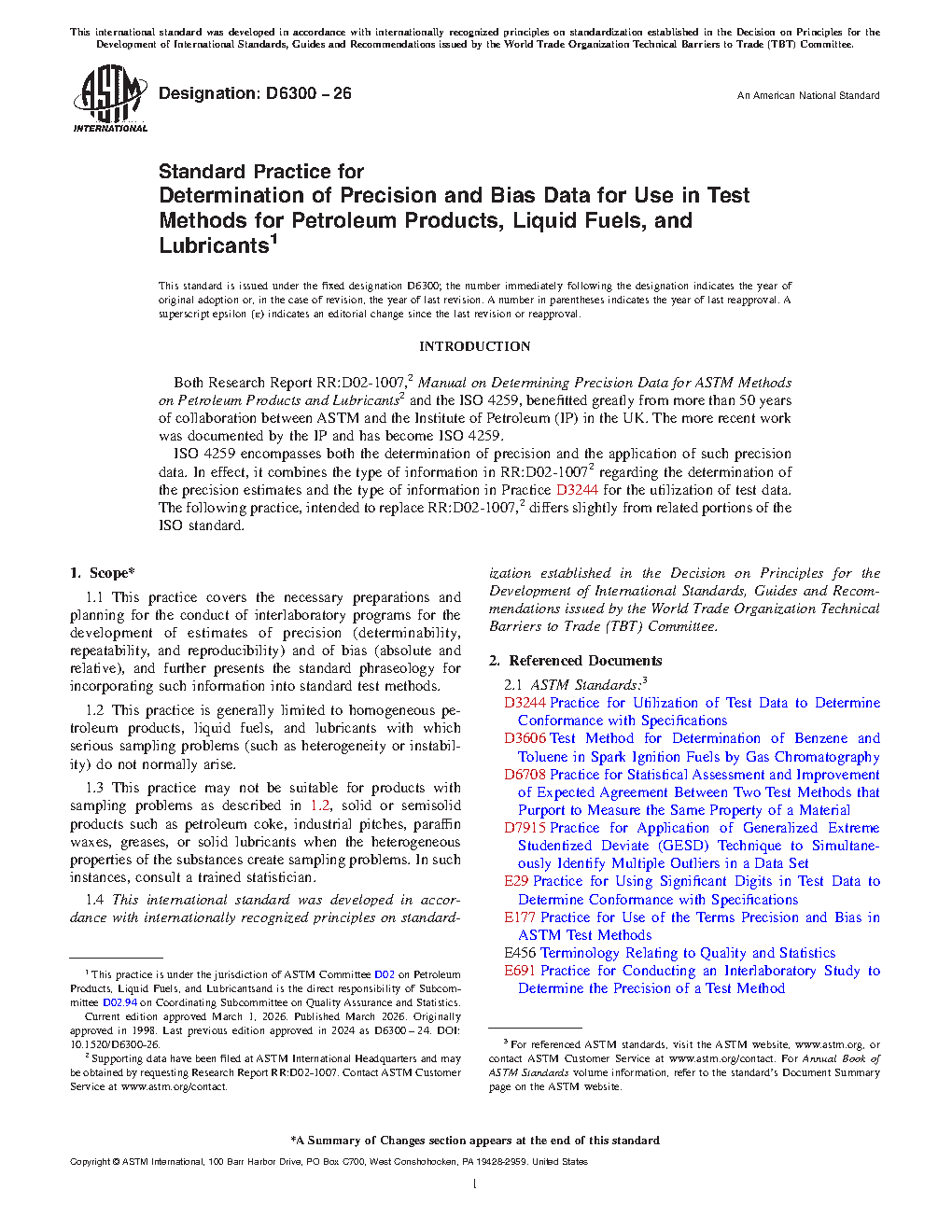
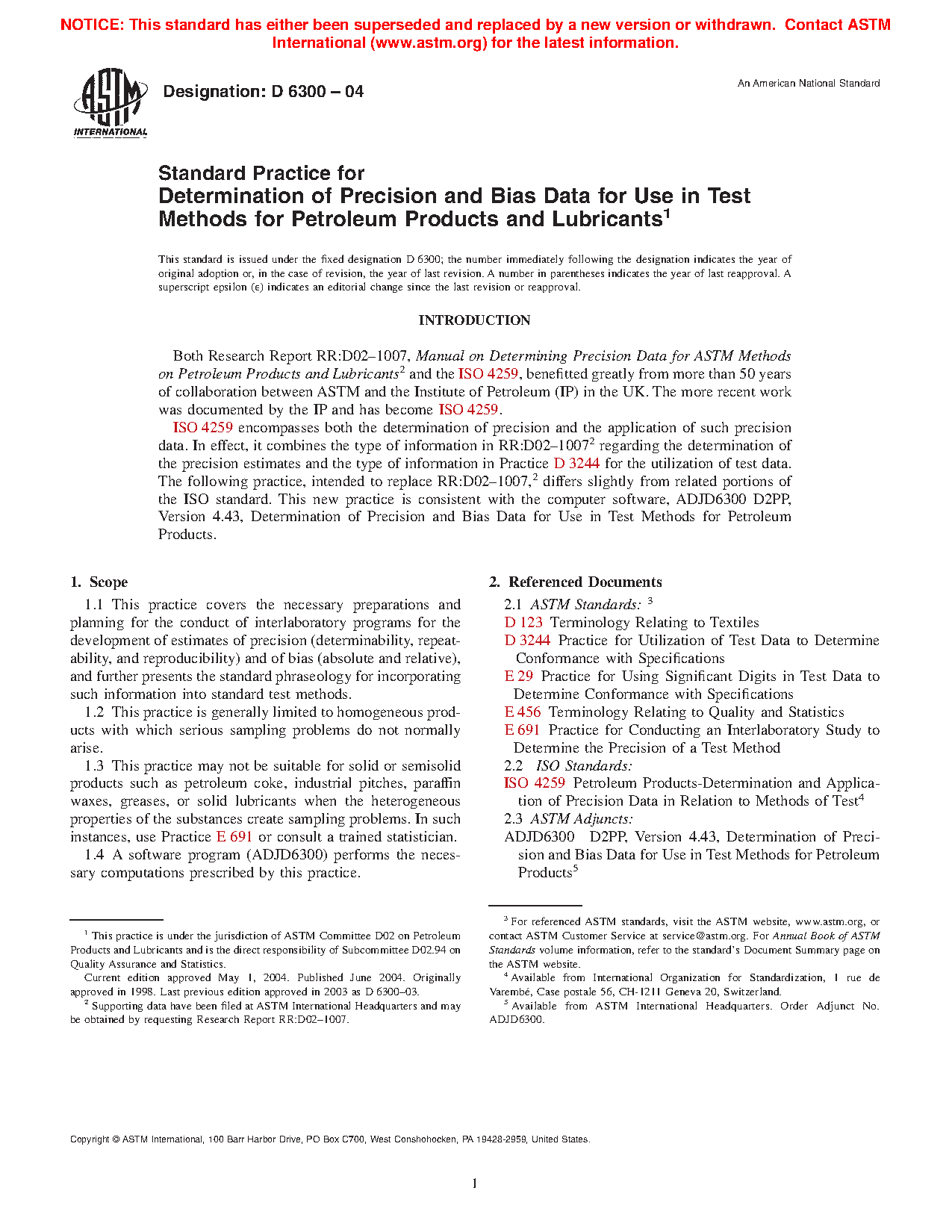
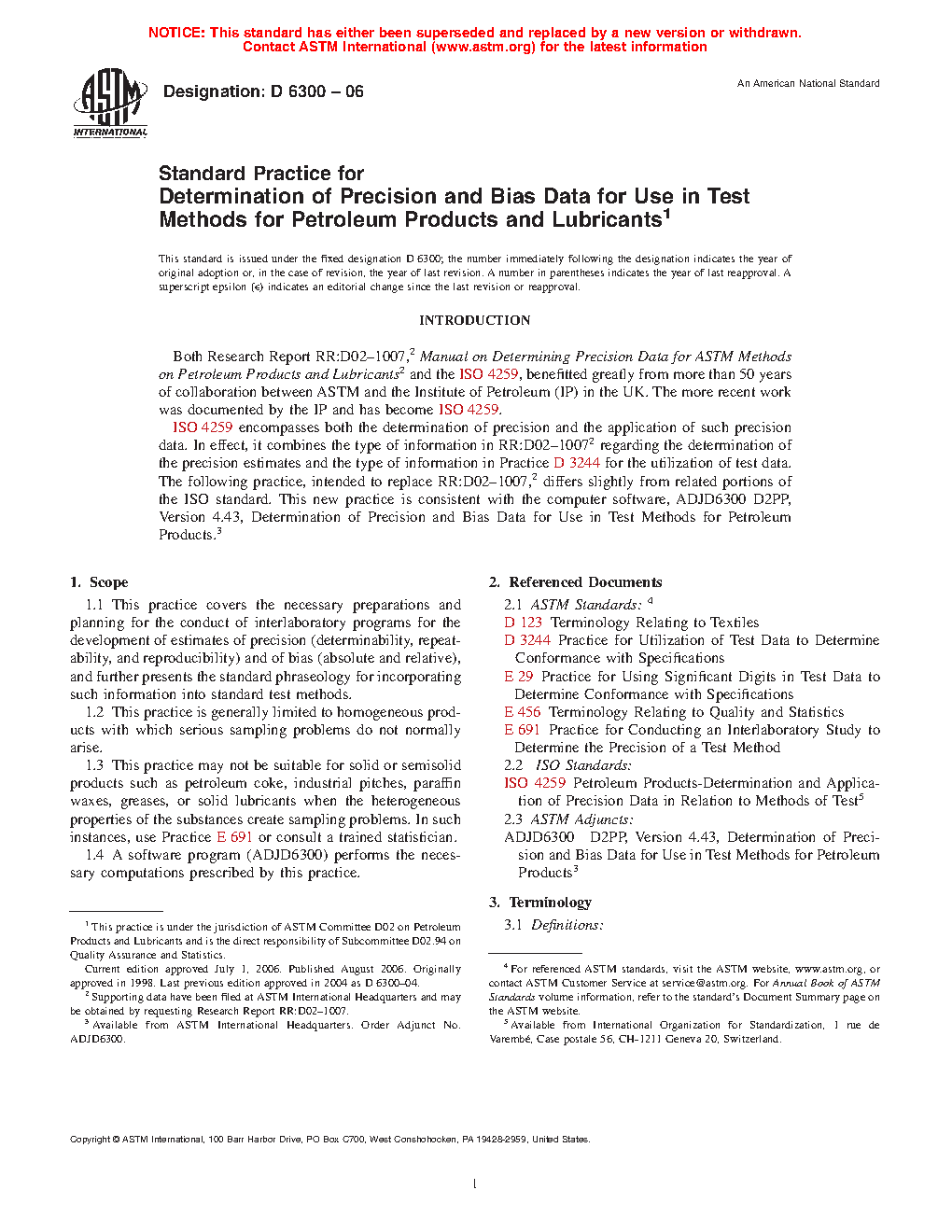
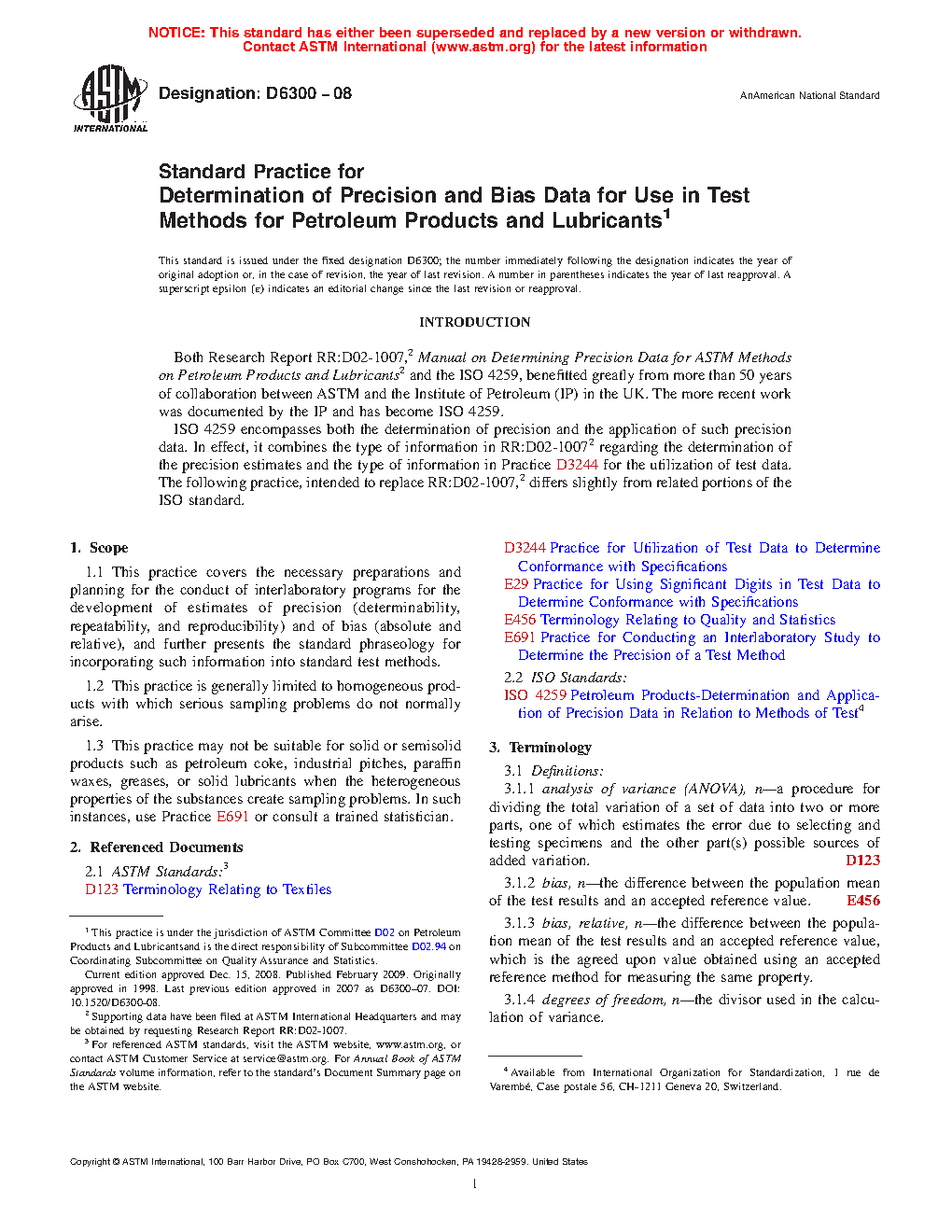
1.1 This practice covers the necessary preparations and planning for the conduct of interlaboratory programs for the development of estimates of precision (determinability, repeatability, and reproducibility) and of bias (absolute and relative), and further presents the standard phraseology for incorporating such information into standard test methods.
1.2 This practice is generally limited to homogeneous petroleum products, liquid fuels, and lubricants with which serious sampling problems (such as heterogeneity or instability) do not normally arise.
1.3 This practice may not be suitable for products with sampling problems as described in 1.2, solid or semisolid products such as petroleum coke, industrial pitches, paraffin waxes, greases, or solid lubricants when the heterogeneous properties of the substances create sampling problems. In such instances, consult a trained statistician.
1.4 This international standard was developed in accordance with internationally recognized principles on standardization established in the Decision on Principles for the Development of International Standards, Guides and Recommendations issued by the World Trade Organization Technical Barriers to Trade (TBT) Committee.
Significance and Use:
5.1 ASTM test methods are frequently intended for use in the manufacture, selling, and buying of materials in accordance with specifications and therefore should provide such precision that when the test is properly performed by a competent operator, the results will be found satisfactory for judging the compliance of the material with the specification. Statements addressing precision and bias are required in ASTM test methods. These then give the user an idea of the precision of the resulting data and its relationship to an accepted reference material or source (if available). Statements addressing determinability are sometimes required as part of the test method procedure in order to provide early warning of a significant degradation of testing quality while processing any series of samples.
5.2 Repeatability and reproducibility are defined in the precision section of every Committee D02 test method. Determinability is defined above in Section 3. The relationship among the three measures of precision can be tabulated in terms of their different sources of variation (see Table 1).
5.2.1 When used, determinability is a mandatory part of the Procedure section. It will allow operators to check their technique for the sequence of operations specified. It also ensures that a result based on the set of determined values is not subject to excessive variability from that source.
5.3 A bias statement furnishes guidelines on the relationship between a set of test results and a related set of accepted reference values. When the bias of a test method is known, a compensating adjustment can be incorporated in the test method.
5.4 This practice is intended for use by D02 subcommittees in determining precision estimates and bias statements to be used in D02 test methods. Its procedures correspond with ISO 4259 and are the basis for the Committee D02 computer software, Calculation of Precision Data: Petroleum Test Methods. The use of this practice replaces that of Research Report RR:D02-1007.
5.5 Standard practices for the calculation of precision have been written by many committees with emphasis on their particular product area. One developed by Committee E11 on Statistics is Practice E691. Practice E691 and this practice differ as outlined in Table 2.
5.6 For properties that are known to change over transport or storage over time, or both, reproducibility obtained by shipping samples to different laboratories will also include property changes incurred over shipping and storage. Therefore, it is not possible to obtain reproducibility due to testing only. The methodology of this practice may allow for the use of different apparatus by different operators from the participating laboratories at a common site if it is desired to estimate the precision of results obtained by different operators from different laboratories using different instruments at a common site due to testing only, and, it is known that the property is reasonably stable over the testing period at the common site. The statistical analysis is not affected since results thus obtained can be treated as results from different laboratories. Therefore, for the precision calculation, each unique operator/apparatus combination is treated as a laboratory. However, the interpretation of the reproducibility value thus obtained should not be interpreted as reproducibility as defined in this practice since the test data is collected under conditions that do not meet all of the reproducibility condition requirements as defined in this practice. The conditions under which the precision data is collected in this case is a form of “intermediate precision conditions” as defined in Practice E177. Therefore, the precision statement shall, in this case, state that this value is to be interpreted as the difference between two single and independent results obtained by different operators from different laboratories using different instruments at a common test site on identical test material within short intervals of time (Note 3) that would be exceeded about 5 % of the time (one case in 20 in the long run) in the normal and correct operation of the test method, and label this precision in a manner consistent with how the test data is obtained. Regardless as to how this precision is labeled in the precision section of the test method, it is recommended that a statement designating it as a form of intermediate precision is included with the precision statement.
Note 3: The short interval of time is based on the single site study conducted at the common site.
Technical characteristics
| Publisher | American Society for Testing and Materials (ASTM International) |
| Publication Date | 03/01/2026 |
| Collection | |
| Page Count | 42 |
| Themes | Petroleum products in general |
| EAN | --- |
| ISBN | --- |
| Weight (in grams) | --- |
Replaces
Previous versions





Collections list