
Nuclear energy :

Overview of the Nuclear Industry up to date


The nuclear industry is undergoing a phase of renewal, though cautious, after a period of stagnation in the 2010s. It remains a strategic pillar for many countries, at the crossroads of energy, climate, economic and geopolitical issues.


Role in the Energy Transition


Nowadays, nuclear power is recognized as a low-carbon, dispatchable source of electricity capable of continuous production. In the context of slowing climate change while reducing dependence on fossil fuels, several countries consider nuclear energy as an essential complement to renewable energies (wind, solar), which are intermittent.
  

A Contrasting Global Landscape


  • Pro-nuclear countries: France, China, Russia, South Korea, and more recently, the United Kingdom and some Eastern European countries are currently investing in new reactors.
  • Retreat from or phase-out of nuclear power: Germany has closed its power plants, while other countries remain hesitant for political, economic, or societal reasons.
  • New entrants: Countries like the United Arab Emirates and Turkey are developing their first nuclear capacity.


Industrial and Economical Challenges


The area is currently facing some obstacles. 

  • ​High costs and budget overruns on major reactor projects.
  • Long construction times, which tend to hinder investment
  • The existing fleet are aging, particularly in Europe and North America, requiring extension or replacement programs.
  • Radioactive waste management, remaining a sensitive political and societal issue.


Innovations and New Technologies


One of the area's greatest hope lies in SMRs (Small Modular Reactors): smaller, standardized reactors that are potentially cheaper and more flexible. Moreover, research is also progressing on:

  •  safer, next-generation reactors,
  • fuel recycling,
  • and, in the longer run, nuclear fusion, which remains experimental.


Geopolitical and Sovereignty Issues


Nuclear energy is closely intertwined with energy sovereignty. Mastering the technology, uranium and the fuel cycle has become strategic, especially in a context of international tensions, added to a search for independence from energy imports.
  

Major Publications Regarding Nuclear Energy

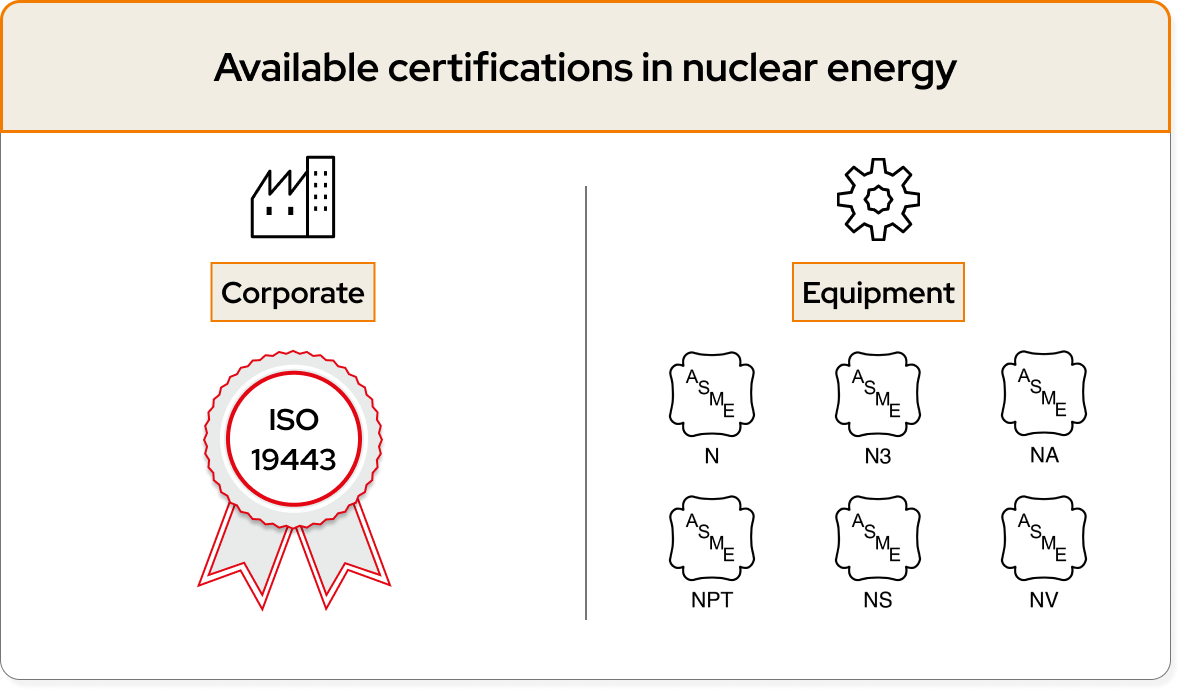
There are many standards focusing on nuclear energy. The most prominent ones are RCC-M, the ASME Code, and ISO 19443.

You can read our detailed brochure in order to know more about the collection of standards related to nuclear energy.

The Certifications


All the documentation related to nuclear energy

DIN 25457-2:2025-10

DIN 25457-2:2025-10

Active Most Recent

Activity measurement methods for the clearance of radioactive substances and nuclear facility components - Part 2: Clearance of residual material

€84.58

View more
DIN 25457-3:2025-10

DIN 25457-3:2025-10

Active Most Recent

Activity measurement methods for the clearance of radioactive substances and nuclear facility components - Part 3: Release of building structures and floor areas

€128.22

View more
DIN IEC 63506:2025-10

DIN IEC 63506:2025-10

Active Most Recent

Calibration of the prompt fission neutron logging tools (IEC 45/1001/CDV:2025); Text in German and English

€69.91

View more
NBN EN ISO 21243:2025

NBN EN ISO 21243:2025

Active Most Recent

Radiation protection - Performance criteria for laboratories performing initial cytogenetic dose assessment of mass casualties in radiological or nuclear emergencies - General principles and application to dicentric assay (ISO 21243:2022)

€92.00

View more
NBN EN ISO 7753:2025

NBN EN ISO 7753:2025

Active Most Recent

Nuclear criticality safety - Use of criticality accident alarm systems for operations (ISO 7753:2023)

€145.00

View more
NBN EN ISO 16646:2025

NBN EN ISO 16646:2025

Active Most Recent

Fusion installations - Criteria for the design and operation of confinement and ventilation systems of tritium fusion facilities and fusion fuel handling facilities (ISO 16646:2024)

€187.00

View more
IEC 61771:1995

IEC 61771:1995

Active Most Recent

IEC 61771:1995 Nuclear power plants - Main control-room - Verification and validation of design

€342.00

View more
IEC 61343:1996

IEC 61343:1996

Active Most Recent

IEC 61343:1996 Nuclear reactor instrumentation - Boiling light water reactors (BWR) - Measurements in the reactor vessel for monitoring adequate cooling within the core

€186.00

View more
IEC 60709:2018

IEC 60709:2018

Active Most Recent

IEC 60709:2018 Nuclear power plants - Instrumentation, control and electrical power systems important to safety - Separation

€342.00

View more
IEC 61500:2018

IEC 61500:2018

Active Most Recent

IEC 61500:2018 Nuclear power plants - Instrumentation and control systems important to safety - Data communication in systems performing category A functions

€133.00

View more
IEC 62138:2018

IEC 62138:2018

Active Most Recent

IEC 62138:2018 Nuclear power plants - Instrumentation and control systems important to safety - Software aspects for computer-based systems performing category B or C functions

€389.00

View more
ISO 15080:2001 (R2024)

ISO 15080:2001 (R2024)

Active Most Recent

Nuclear facilities — Ventilation penetrations for shielded enclosures

This product is not for sale, please contact us for more information

View more
NBN ISO 4917-5:2025

NBN ISO 4917-5:2025

Active Most Recent

Design of nuclear power plants against seismic events — Part 5: Seismic instrumentation

€58.00

View more
NF M60-312-2 (11/2025)

NF M60-312-2 (11/2025)

Active Most Recent

Énergie nucléaire - Mesure de la radioactivité dans l'environnement - Détermination de l'activité du tritium dans l'air - Partie 2 : méthode d'essai à l'aide d'un prélèvement par captage sans dilution de la vapeur d'eau dans l'air

€107.50

View more
ISO 11482:1993 (R2013)

ISO 11482:1993 (R2013)

Active Most Recent

Guidelines for plutonium dioxide (PuO2) sampling in a nuclear reprocessing plant

€51.00

View more